Dennis Anderson: He's like any other virtuoso, except he blows a duck call and is a world champ
Published in Outdoors
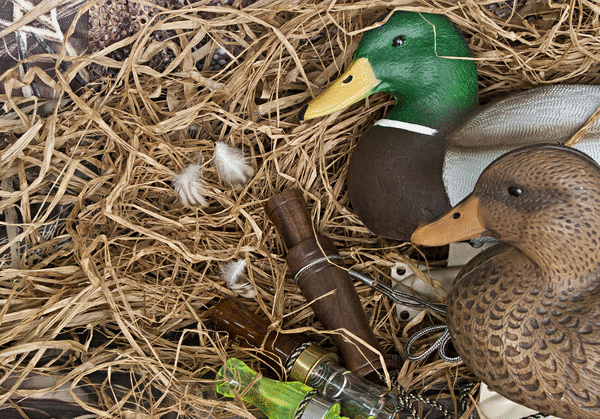
MINNEAPOLIS — Mike Anderson perhaps could have been first chair in the St. Paul Chamber Orchestra, playing clarinet or oboe or another of the reed instruments.
Instead, Anderson blows a duck call. He’s obsessed with it, really — the high balls and the feeding chuckles that can fool mallards and other wild fowl into thinking Anderson is one of them.
When in fact he’s an elevator repairman from Mankato.
Recently, Anderson — who will be at Game Fair for two weekends beginning Friday, Aug. 7 — won his second world championship duck calling contest.
Sponsored by Delta Waterfowl, Mack’s Prairie Wings and Drake Waterfowl, the Grand National Duck Calling Contest in Des Moines was open only to contestants blowing double-reed calls.
“In a double-reed contest, the calls are more like the type used in actual hunting situations,” Anderson said. “A double-reed has less volume and less versatility than the type of calls we use in some other contests. But we’re all still trying to emulate a flock of ducks, so nothing’s changed there.”
This is Anderson’s second world championship win. In 2009, he stepped onto the Main Street Stage in Stuttgart, Ark., and blew a call better than 67 other competitors, becoming the first Minnesota resident to win the famous World Championship Duck Calling Contest.
In four attempts at the big Stuttgart competition, it was his first win.
An oddity at the time, in that Anderson wasn’t a Southerner and he didn’t represent a duck-call manufacturer, he nevertheless coaxed from his call enough duck-like pleadings to impress the contest’s five judges.
Anderson bested second-place finisher and hometown favorite Tyler Merritt of El Paso, Ark., in a contest that was broadcast live on ESPN.
“In Stuttgart, the contest is about showing off the range of your calling, from top to bottom, during the 90 seconds each competitor has,” Anderson said.
Anderson, 46, was born in Monticello but grew up in Brainerd. His family-owned property is near Hackensack, Minn., and it was there, among beaver sloughs and ponds, that he first learned to hunt ducks.
Later, his dad was among a small group that leased a marsh, together with an old farmhouse, near Herman, in the west-central part of the state.
“The farmhouse wasn’t much, but we slept in it late in the season,” Anderson said.
Anderson witnessed his first duck-calling competition at Game Fair in 1988. Quickly he became obsessed with the possibility that, with practice, he could bring home a trophy or two.
In the process, he thought, he might also learn how to lure more ducks to his decoys during fall hunting seasons.
“I went to Gander Mountain immediately after attending Game Fair that year and bought an acrylic call for $130,” Anderson said. “This was before the internet, obviously, so all I had to learn from was a VHS tape that I watched hundreds of times.”
Anderson would go on to win the Minnesota state duck calling championship four times. But not before an inauspicious start.
“In early 2001, I entered my first contest, in Burlington, Iowa,” he said. “I thought I was pretty good. But I left knowing I was not very good. The duck call I had was good. But the structure of my routine, and my overall presentation needed work.”
Passionate not only about duck calling but pursuing ducks, Anderson has hunted waterfowl throughout southern Minnesota and is particularly keen to chase mallards along rivers — any rivers.
In autumn, Missouri, Nebraska and Arkansas are among his waterfowling destinations. Sometimes friends and family members accompany him. But always his black Labrador, Ash, is by his side.
“I’ve had three good dogs in my lifetime, and she’s one of them,” he said.
Though he never lost interest in competitive duck calling, Anderson stepped back from the big stage for about 10 years after winning in Stuttgart in 2009.
His other passion is baseball, and he wanted to coach his son’s team.
“I played amateur baseball, and I love to coach,” he said. “I enjoy impacting lives. That’s why I like being around young people. I was the varsity baseball coach at New Ulm the last two years.”
Anderson also used his time away from competition to develop his own line of duck calls, a dream of every caller, he said. Anderson Championship Calls will have a booth at Game Fair, and the champ himself will be on hand to inspire hunters and competitive callers — just like he was inspired more than 30 years ago at the same outdoors festival.
In addition to the event in Des Moines, Anderson has attended outdoor expos this summer in Nebraska and Missouri. He is in Memphis this weekend for the big Ducks Unlimited show before returning to Minnesota for Game Fair.
“Almost all duck calls today are made of acrylic, and mine are, too,” Anderson said. “I have them turned on a CNC machine in Arkansas, then I engrave the logo on the barrel and hand tune each call myself. I can tune between 200 and 300 a day.”
Of Anderson’s two calls, the Money Cut and the Wingman, the Money Cut, he said, is the louder call and perhaps more open to freewheeling intonations, while the Wingman might be slightly more user-friendly.
Game Fair hours on Aug. 7-9 and Aug. 14-16 are 9 a.m. to 5 p.m. See gamefair.com for admission costs, directions and exhibitor information.
©2026 The Minnesota Star Tribune. Visit startribune.com. Distributed by Tribune Content Agency, LLC






Comments