Puget Sound's viral 'shark wrestler' tells his side of the story
Published in Outdoors
TACOMA, Wash. — Recently, a jarring video hit the Washington Department of Fish and Wildlife Police Facebook page that shows an officer popping out of the dark on the Fox Island Pier in Pierce County and yelling, “You, come over here now! Police!”
It was like something out of an old episode of “Cops,” before the officer’s tone gently downshifted into, “You know your shark rules ... .”
It was almost as if the officer knew the offender. As it turned out, he did. The WDFW had been investigating him for months. Fourteen complaints had been submitted to the WDFW about the man’s handling of fish, sharks in particular, with 11 of the complaints about sixgill and sevengill sharks, which are illegal to fish for in Washington.
The shark fisherman in question’s name is Connor Seifert. His social-media presence drew attention to his shark fishing (and catching) tactics and prompted social-media scrollers to complain to the WDFW.
Shortly after the WDFW bodycam video came out, local and national news outlets reposted the video, accusing Seifert of “wrestling” the sharks and calling his behavior “bizarre” and that he was only “fishing for clout.”
The Daily Beast reported that he was arrested, which he was not.
Seifert was briefly detained and then released. In the WDFW video, there are clips from his social-media pages that appear to show him holding sharks that are illegal to fish for, both in the air and upside down on the ground. His methods for hook retrieval look grotesque at best.
If his actions are illegal and he knew that, why in the world would he post them on social media for all the world to see? Was he just ignorant of the rules?
The WDFW police officer in the video certainly didn’t think so. “You know your shark rules!” was one of the first things shouted at Seifert in the bodycam clip.
So who is Seifert? A notorious shark wrestler looking for attention or an unfairly targeted man attempting to start up a fishing business? The News Tribune caught up with Seifert over the phone from his home in St. Helens, Ore., last Monday to learn a little more about what happened and the muddy waters surrounding him.
The video in question
The WDFW police state in their now viral Facebook post from July 23 that Seifert was targeting sixgill sharks, and then unlawfully removing them from the water. Sixgill and sevengill sharks are both listed as a “Species of Greatest Conservation Need,” per Washington’s State Wildlife Action Plan, and neither are legal to fish.
The laws between the two sharks differ in how they’re handled if accidentally reeled in.
Sixgills, which use Puget Sound as a nursery, may not be removed lawfully from the water when releasing them–they must be kept fully submerged in the water at all times. There is no law against temporarily removing a sevengill from the water before releasing it back into the water, though it’s best practice to keep a fish one intends to release fully submerged when possible.
Sixgill and sevengill sharks are legal to fish in other states like California, and other countries from Mexico to Argentina, but are protected in the Pacific Northwest, Alaska and Canada.
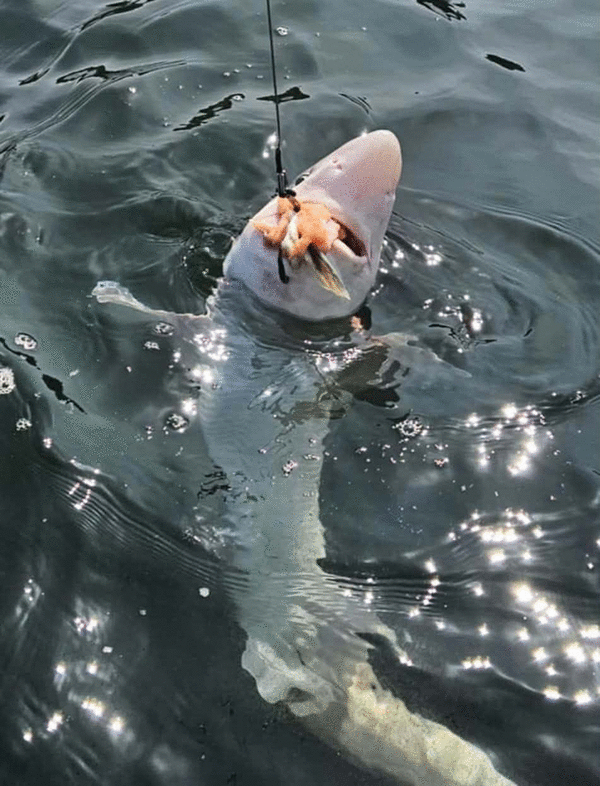
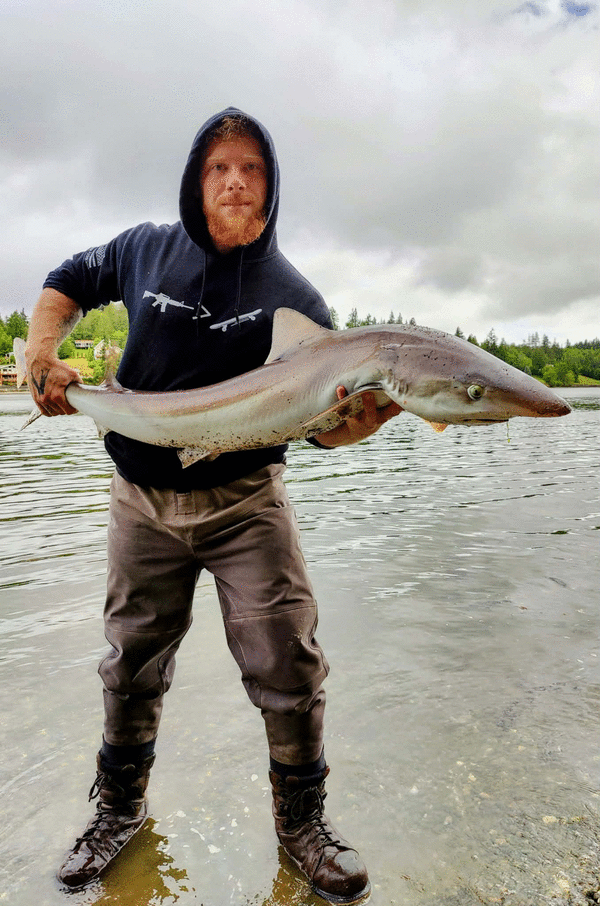
Seifert says to watch the video WDFW posted again. The sharks you see are not sixgill, in fact, but sevengill sharks, he says, and they were accidentally reeled in while fishing for legal bottom feeders.
There are at least 11 species of shark found in Puget Sound, and most are legal to fish, like the Pacific spiny dogfish and soupfin shark. These are the species Seifert says he was fishing for.
He eats them.
“I mainly fish for soupfin,” he told The News Tribune over the phone last Monday. “They taste incredible.”
In fact, when the WDFW sting operation hit its climax on June 13 on the Fox Island Pier, after months of investigations, and had an officer pop out of the bushes and surprise Seifert after catching him in the act of reeling in a sixgill shark, Seifert says he’d already caught many legal fish with the same gear.
“I had the conversation with multiple different people that day that we were fishing for soupfin and didn’t mean to catch a sixgill,” Seifert said. “And the warden there insisted that our gear was too big to catch any of the species that we were claiming to, despite the fact that he literally watched us pull in over a dozen dogfish with that same gear. He was hiding, and then as soon as that sixgill came in, he revealed himself.”
The News Tribune reached out to the Washington Department of Fish and Wildlife to ask how a fisherman could control what type of shark they’re fishing for and how to avoid reeling in a protected shark instead of a legal one.
“Anglers utilize fishing gear (fishing line, size of rod/reel, size of hook, wire versus monofilament fishing leader, bait being used, and size of) chosen to have the highest likelihood of hooking target species,” Becky Elder, the WDFW police communications manager, emailed back. “Spiny Dogfish are routinely caught as bycatch by salmon fishermen and commonly caught by bottomfish anglers in Puget Sound.
“The fishing gear, bait, and hook size most commonly used to catch dogfish is similar to salmon fishing gear. Anglers utilizing this gear would most likely not encounter a sevengill or sixgill shark, as the large shark would break the angler’s fishing line.
“Officers in this case utilized articulable facts to identify that the suspect was unlawfully targeting sixgill and sevengill sharks. These articulable facts in part included: time and place of fishing effort, the size of fishing gear and tackle used, the use of extremely large pieces of bait only large sharks could fit their mouth around. Your average spiny dogfish/bottomfish angler would not be using the appropriate gear to hook and land a sixgill shark.”
The shark wrestling
The video released by the WDFW included body-cam footage of the officer confronting Seifert after he allegedly pulled a sixgill shark out of the water and took a photo of it, for what they call a “trophy photo,” before releasing it, intercut with Seifert’s own social-media videos.
In one clip, he has a shark out of the water and is holding it up by its tail. On another, a small shark is flipped onto its back by the waterline.
They’re hard to watch, and certainly appear to be mishandled. But Seifert says those specific sharks were not illegal, and he had good reason to act the way he did in both clips.
“It’s not illegal to remove a sevengill shark from the water, and those were both sevengills,” Seifert says. “They’re not legal to target, but they’re legal to pull out and handle when they come in.
“Dealing with a shark is crazy,” Seifert continued. “They’re large animals, and they’re as flexible as a snake. They can turn around and bite their tails in an instant. They’re incredibly difficult to handle. Especially when they’re in the water. So, getting them into shallower water makes it easier both on the handler and the animal to be released safely.”
Seifert says the first clip from the WDFW video was a broadnose sevengill shark. He says he and his friends were fishing for dogfish, and his friend had the sevengill bite his line off, then get tangled in it. Seifert caught it by hand and untangled it.
As far as the one that got flipped upside down by the waterline, Seifert says that too was by design.
“A lot of the time, I flip the animal on its back so it’s belly up. It basically puts it to sleep. That’s the easiest way to handle them and remove the hook without them thrashing around, hurting themselves or trying to bite you.
“That’s what those videos are showing.”
What now?
After being briefly detained by the WDFW officer on June 13, Seifert, 27, was charged with nine counts of unlawful recreational fishing in the second degree and one count of giving a false statement to a public servant.
He has obtained a lawyer and has a pre-trial conference at the Pierce County courthouse on Aug. 27.
“This is stressing me out a lot,” Seifert says. “I’m young, and I recently went through a divorce, and lost a lot of money for that. And now I’ve spent almost $9,000 on my attorney before even going to trial.”
Fishing is a hobby now for Seifert, though he says he hopes to someday guide sturgeon trips on the Columbia River.
“Sturgeon are my favorite fish,” he says.
He also breeds snakes.
He says all the negative publicity tied to his name isn’t helping drum up future business.
“I’m not the guy who’s out there to harm these animals. I’ve gone out of my way to stop people from poaching sharks and sturgeon. And yet they (WDFW) are targeting me even though I’ve worked with them for years.”
In 2022, Seifert reeled in the first documented sevengill shark in the state of Washington. He posted it on social media, and then somebody immediately reported him for catching a sixgill.
After being alerted, NOAA (National Oceanic and Atmospheric Administration) showed up at Seifert’s door.
“It originally freaked me out that they were there, but WDFW and NOAA said it was fine, and they knew it was a sevengill.”
It turns out they just wanted to know where he caught it so that they could put him into contact with local researchers.
“After that, they gave local fishermen in the area some tags to put on sevengill sharks and some cameras, which was pretty cool to see what they were doing,” Seifert says. “I think everyone learned a lot from that, which was great.”
The News Tribune reached out to WDFW, and it verified Seifert’s story.
“I love these animals, and I love being able to see them in the Sound and don’t want to hurt them. It sucks to be demonized,” Seifert says. “And it’s not just for me. That’s for anyone that is fishing for bottom fish on the Puget Sound. There’s no way to target one shark over another specifically. They all bite the same thing.”
It’s clear that the WDFW thinks otherwise.
© 2026 The News Tribune (Tacoma, Wash.). Visit www.TheNewsTribune.com. Distributed by Tribune Content Agency, LLC.






Comments