LA asks 2028 Olympics organizers to buy insurance in case disaster cancels the Games
Published in Olympics
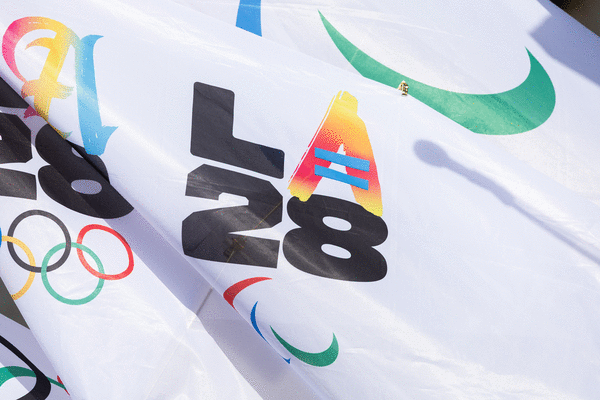
LOS ANGELES — Los Angeles has asked organizers of the 2028 Summer Olympics to take out a $650-million insurance policy, and agree to cover any potential losses above that amount, should the Games be canceled by a calamity.
City Administrative Officer Matt Szabo requested the enhanced risk management protection in a letter to a top LA28 official this week, noting that such protection has been the norm in most Olympics since the 2001 terrorist attack on the U.S.
Event cancellation insurance protects Olympic hosts in the event that a natural disaster, terrorist threat, health emergency or other unforeseen event disrupts the quadrennial sports extravaganza.
World Wars I and II forced the cancellation of the Olympics, and Tokyo postponed the 2020 Summer Olympics until 2021 because of the COVID-19 pandemic. The Tokyo organizers estimated that they lost $3 billion because the pandemic severely limited the number of spectators allowed to gather for events, eviscerating ticket sales and sponsorship revenue.
Tokyo had taken out a $650-million insurance policy on the Games, according to a report by Szabo's office.
In response to the request, the Olympic organizing group LA28 released a statement saying it "continues to engage with the City pursuant to its obligations in the Games Agreement by sharing required insurance policies and engaging with City partners regarding those policies."
The exchange came on a day when City Council members, responding to a story in The Los Angeles Times, said they wanted the Olympic organizing organization to disclose more details of its finances — particularly contracts of $1 million and more. LA28 has not listed those contracts in recent annual reports, which council President Marqueece Harris-Dawson said Wednesday created a "troubling picture" and threatened the relationship between the city and Olympic organizers.
On the question of insurance, Szabo said in a letter to John Harper, chief operating officer of LA28, that the two parties already have been discussing event cancellation insurance for one of the Olympic venues in the San Fernando Valley, where three-on-three basketball, skateboarding and BMX cycling events have been scheduled.
Szabo, who advises the City Council and Mayor Karen Bass, wrote in a report that it would make more sense for LA28 and the city to have a single risk management plan for "the Games in their entirety."
The city administrative officer said that his office had found that all but one Olympic organizing committee since the Athens Olympics of 2004 had purchased event cancellation coverage.
The city estimated that Athens obtained coverage for a limit of $170 million, Beijing $300 million, London $400 million and Rio de Janeiro $1 billion. Paris, host of the 2024 Olympics, was the lone exception.
The protection for the Japanese Games turned out to be well warranted. Organizers initially sold about 4.5 million tickets and projected huge financial gains from Olympic tourism. But the Tokyo organizers decided the pandemic made it too dangerous for foreign visitors to attend, before deciding that even domestic spectators had to be ruled out. That meant an $815-million hit to ticket revenues alone, Reuters reported at the time.
The organizing committees in all of the Olympic cities since 2004 not only obtained insurance but agreed they would put no cap on their liability beyond the coverage limits, Szabo said in his report to L.A. officials. The top City Hall administrator said the city-LA28 contract already requires the Olympic organizing group to provide extended coverage for any losses.
Paris didn't underwrite insurance for that Olympics because of a substantial increase in cost that followed Tokyo's COVID-driven losses in 2020, according to industry trade reports.
Atlas Magazine, which tracks the insurance industry, cited multiple factors for Paris' failure to obtain coverage, including "the lack of reinsurance capacity with the withdrawal of the major reinsurers, and the increase in the risks of natural disasters, pandemics, terrorism and riots."
Officials in the city's risk management division said they learned that the insurance market for major events has recovered in recent years. They said that the organizers of soccer's World Cup this summer managed to secure about $1 billion in coverage.
The City Hall analysts said that LA28 has some insurance for a potential interruption or cancellation of the Games. But they want the coverage increased. LA28 should "procure $650 million of event cancellation coverage or the maximum commercially reasonable limits available based on global market capacity," Szabo's letter says.
City officials said they didn't want LA28 to be stuck with insurance so expensive that it would do excessive damage to the event's bottom line.
Under a 2021 contract, the city can ask the Olympic organizers to make changes in their insurance coverage. Szabo said in his letter that the contract, known as the Games Agreement, requires LA28 to respond in writing within 30 days.
The City Council's committee on the Olympics heard about the insurance request Wednesday and also got an update on the dispute with LA28 over what the group discloses in its annual reports.
Szabo told the committee that LA28 has shared information on $1-million-plus contracts in private meetings but not in its public report, as required in a 2021 contract. Szabo and the city's chief legislative analyst have asked for the list of contractors to be made public. But LA28 has so far declined to do so.
Councilmembers Hugo Soto-Martinez and Katy Yaroslavsky joined Harris-Dawson in saying the contract information should be released.
"It's inadequate, what's provided," Yaroslavsky said, "and I would like to know what leverage we have to get them to comply."
Harris-Dawson also expressed concern that LA28 was resisting requests by him and others that it award a share of its contracts to businesses based in the city of L.A. The Games organizers say that such a requirement would tie their hands and drive up costs.
The lack of progress on business guarantees for L.A. firms and failure to list the companies getting contracts "together paints a very troubling picture," said Harris-Dawson. "And in the absence of information people will come up with their own story."
Szabo and Sharon Tso, the chief legislative analyst, said they are waiting for LA28's formal response on releasing a list of its contractors.
The council's discussion followed a story Monday in The Times that detailed how LA28 failed to adhere to the strict annual reporting requirements spelled out in the organization's 2021 contract with the city.
The reports in the last two years failed to spell out the companies that received contracts of $1 million or more and the amounts of those deals. They also did not outline the specific coverage amounts of insurance policies. And they do not offer schedules and budgets for the work that must be done to prepare dozens of Olympic venues for competition.
City Controller Kenneth Mejia sent a letter in August asking LA28 to provide more complete financial disclosures. Besides details on contracts, insurance and venues, Mejia asked for financial statements that compare revenue and spending forecasts to actual performance; bank statements on the contingency fund LA28 must maintain to cover potential losses, annual financial forecasts and a more granular breakdown of broad budget categories now labeled only "other revenues" and "other expenses."
The Olympic organizing group, a private nonprofit, has declined to provide the controller with additional information. LA28 officials said they had been sharing many of the requested details with other city officials. They also argued that revealing contract specifics would hurt their ability to secure the best deals with future contractors.
____
©2026 Los Angeles Times. Visit latimes.com. Distributed by Tribune Content Agency, LLC.





Comments