History says the 2026 Broncos will fall to earth in close games. Can Sean Payton fight the bell curve?
Published in Football
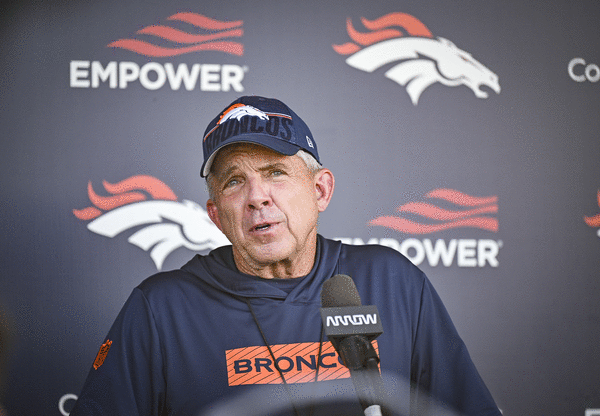
DENVER — By the end of a cool mid-December night in Denver, with orange backs pressed up against a wall that had become all too familiar, the only number that really mattered to the Broncos was Courtland Sutton’s. Find 14. When they needed a play, as tight end Adam Trautman marveled later that night, they always found 14. And so head coach Sean Payton sent out his offense on a fourth-and-3 against the Packers, and Sutton ran a go route — 3 yards be damned — and came down with the 26-yard-grab that helped ensure another tight win in a season on the brink.
Eleven straight wins, at that point, after a 34-26 victory over Green Bay. Nine straight wins in one-score games. Payton had bent nature’s laws of regression to his will, and placed these Broncos back in an analog era of football, where spine and guts and heart felt as if they mattered more than math itself.
“That’s why the whole, analytic things don’t work,” Payton said that night, asked about his trust in Sutton to call for a fade ball on a fourth-and-short. “Because the analytics don’t tell you who (is) the quarterback, and how the other team’s doing offensively. So, I know they want it to work. But it doesn’t.”
Who was “they,” exactly? Unspecific. Broadly applicable. They was a construct the hard-nosed Payton got his Broncos to believe in throughout 2025: that anyone championing Denver’s statistical flaws couldn’t see inside the building’s DNA. They was Vegas, often labeling his Broncos as underdogs despite their mountain of wins. They was the social-media and talking-head mob claiming, in one way or another, that his Broncos were schedule merchants.
And only after the magic evaporated in the snap of quarterback Bo Nix’s ankle, after a 14-3 season ended in the AFC Championship game, would Payton hint that they were — well, kind of right.
“From my lens,” Payton said at February’s NFL Combine, “we won a lot of games by one score or less, right? And I’m not naive enough to think those games couldn’t have swung, and you could grab any two or three. But where’s the meat on the bone?”
“Relative to,” Payton continued a few sentences later, “a number of things that we won despite maybe not being as good as others. And I think that’s the only way to look at it, relative to this team writing its own chapter, and getting us to where we want to go. Which is obviously, a game and a half further than where we went.”
Months later, with the dawn of a new season, Payton said point-blank Wednesday he believed these 2026 Broncos indeed possess all the necessary ingredients to win a Super Bowl. Getting there, though, will require an entirely different formula for winning football games.
History suggests it is nearly impossible for Denver to repeat last year’s success — 11-2 in the regular season — in one-score games. The bell curve has come for contenders far and wide who have lived on the margins. And for his greatest trick in Denver yet, Payton will be tasked this season with besting a key concept in the world of “analytic things,” as he once put it: statistical regression to the mean.
He knows.
“The best way to get better in those one-score games,” Payton said Wednesday, “is to find yourselves not in as many. And I mean that. Like, I don’t want to chase that (11) of 13 again. You’d like to not be in as many.”
Living on the edge
A season of clenched fists and bitten fingernails in the Mile High City, ultimately, ended in strange and rarified air. According to NFL season data compiled and analyzed by The Denver Post, the 2025 Broncos tied with two teams — the 2024 Kansas City Chiefs and the 2022 Minnesota Vikings — for the most one-score wins (11) in any season in the last decade.
A compliment. Also a cautionary tale. Those 2024 Chiefs cratered from 15-2 to 6-11 in 2025. Those 2022 Vikings cratered from 13-4 to 7-10 in 2023. The pendulum swung and toppled hopes in the process.
“You would expect at some point that some of those games – if you’re heavily lopsided one way, you would expect that it falls a little bit, right?” said one NFL front-office staffer involved in football research.
Widen the sample size, and the results are even more stark. There have been 30 other NFL teams in the past decade that have approached the 2025 Broncos’ regular-season profile: at least 12 total regular-season wins, at least five one-score wins, and at least a 70% win rate in one-score games.
In total, those teams combined to win 49% of their one-score games the following season, according to The Post’s research.
“When you look at the one-score games, it’s like — how much is that Sean Payton, how much is that Bo, how much is that Evan (Rothstein), how much is that Vance, on the defenses that he’s calling?” one NFL game-management coordinator told The Post, speaking on condition of anonymity to discuss another organization.
“Like, I don’t know that answer without being in that building, without studying them. But I think that’ll be the most difficult thing for the Broncos, is sustaining that success.”
The answer, of course, is all of the above. Nix has simply played his best football, both by the eye test and by sheer numbers, in high-leverage situations. Rothstein, hired in 2024 as the Broncos’ director of game management, plays a quietly vital role in late-game situational execution. And Denver’s entire franchise identity has coalesced around the situational strength and constant pressure from Joseph’s defenses.
But they are led, too, by a head coach with a statistical familiarity and comfort in close-game situations. Payton is 79-63 all-time in the regular season in one-score games, according to The Post’s research. Only two of those aforementioned 30 teams, too, have actually won a higher percentage of one-score games in their next season: Payton’s 2018-to-2019 Saints are one of them.
The 62-year-old head coach, however, does not have enough pride to assume he can repeat it.
“He’s made clear to us as players that, hey, it’s really cool that we have this backbone to, like, not flinch in one-score games, and almost have a clutch element to our defense and to our offense,” All-Pro guard Quinn Meinerz said Tuesday. “But I think it was like, a historic 11-2. That doesn’t happen very often. And so, staying out of those situations and capitalizing earlier in those games.
“And I think we all kind of felt that — our offense kinda took a little bit to get going,” Meinerz continued. “It was very slow. You know how a train fully gets loaded up? It takes a long time for that train to get going. But once it does, we had a lot of success there. So, that’s going to be our emphasis here in camp.”
Turning the tide on turnovers
Across NFL front offices and coaching staffs, this skew has long been learned and feared as reality. Ask Marvin Lewis, who once earned a Coach of the Year nod for piloting the 2009 Cincinnati Bengals to an AFC North title on the back of a 6-3 record in one-score games.
The 2010 Bengals went out and signed Hall of Fame receiver Terrell Owens to a one-year deal, were widely praised for a loaded roster, and promptly fell to 2-8 in one-score games en route to a 4-12 overall finish.
“Won a lot of close games, and everybody thought we were one player away,” Lewis said, reflecting on 2009. “Well, you’re never one player away. And that’s kind of what I’m saying about Denver.”
A few short weeks after Payton’s “meat on the bone” comments at the combine, the Broncos swung for a great equalizer. Receiver Jaylen Waddle, brought from Miami for hefty draft capital, gives Nix and Payton the quick-twitch offensive weapon they haven’t had. Payton said this week the “knowledge we had with all the other pieces” was important to the deal for Waddle — a clear acknowledgment that Denver views the 2021 first-round pick as the missing piece.
Elsewhere, though, Denver explicitly chose not to upgrade externally. The club re-signed 17 of 22 in-house free agents in the offseason, and Waddle and third-round pick Tyler Onyedim are the only two newcomers who’ve made consistent appearances on first and second-team units in the first week of the Broncos’ training camp. Waddle, as Lewis pointed out, is a massive upgrade who single-handedly ensures opposing secondaries can’t shift coverages toward Sutton; he also does not single-handedly represent enough roster churn to widen all of Denver’s margins for error.
“The thing that I’ve seen, and I know we struggled with it in Cincinnati, is just making sure that the third or the fourth guy was good enough,” Lewis said.
Instead, the Broncos’ means for putting games away earlier hinge on self-improvement. A massive area of variance that actually could swing Denver’s way in 2026: turnovers, where Joseph’s defense somehow finished tied for 26th in the NFL in takeaways despite surrendering the third-fewest points per game in the league. Safety Talanoa Hufanga said Thursday that such emphasis has already been communicated, as Denver’s interior defensive linemen are doing sled drills in camp that involve sticking a hand up to deflect a pass and finish the rep.
“We did a really good job of getting sacks, but how can we get a sack and a forced fumble? Or how can we change this pass deflection into an interception or a tip, just to get somebody else to get an interception?” Hufanga said. “It’s been talked about, and it’s been drilled.”
Negative regression looms on Denver’s schedule, too, if the Broncos don’t race in front of it. One former high-ranking NFL personnel executive pointed out to The Post that the Broncos faced a lengthy stretch of “epically bad” passing offenses in 2025; Denver racked up four regular-season wins against backup quarterbacks. The AFC West will likely be tougher this go-around, as bottom-feeding Las Vegas spent handsomely to upgrade its roster and Kansas City returns a healthy Patrick Mahomes.
All of it means, simply, that the Broncos know they need to live less dangerously — or risk falling into the void of statistical variance.
“Don’t leave opportunities on the table the way that we feel that we did a year ago,” offensive tackle Mike McGlinchey said Thursday, asked on maneuvering around one-score games. “And being able to jump out and take control of the game as we want to, and dictate the flow of how football games are played.”
____
©2026 MediaNews Group, Inc. Visit at denverpost.com. Distributed by Tribune Content Agency, LLC.






Comments