Gautam Mukunda: Elon Musk surprisingly doesn't understand abundance
Published in Op Eds
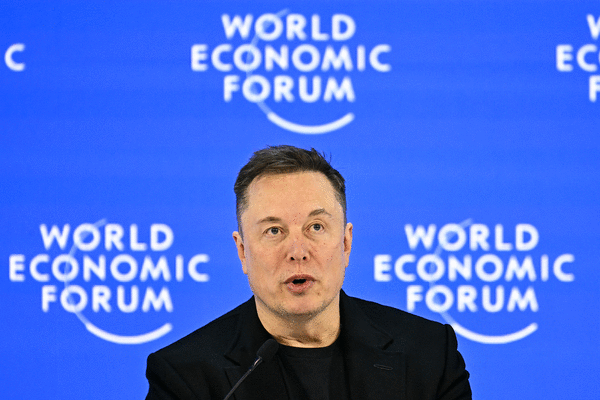
Elon Musk, the world’s first trillionaire, told The Economist editor-in-chief Zanny Minto Beddoes in a recent interview that money won’t matter in 2036. He invoked a Star Trek-like future where robots and artificial intelligence will make us so wealthy that work will become a hobby like gardening and not a necessity.
We’ve seen such predictions before, and we don’t have to read science fiction to know what people who don’t have to work are like. Abundance can abolish want. It can’t abolish the human need for status. The fight over what’s left is not the idyllic world Musk predicts.
Musk’s own behavior shows just how much he cares about status. In February 2023, after his Super Bowl post drew fewer views than President Joe Biden’s, the newsletter Platformer reported that Twitter brought in roughly 80 engineers overnight to build a “power user multiplier” that boosted his posts by a factor of 1,000 and applied to him alone.
Knowingly or not, Musk’s comments echo those of economist John Maynard Keynes, who predicted in 1930 that within a century we would work perhaps 15 hours a week, and that we would be glad of “small duties and tasks and routines” — gardening, for instance — to fill the time. Almost 100 years later we’re still at 40 hours and often many more.
When most of us think of a post-scarcity world, we, like Musk, envision Star Trek. But look at how Starfleet works. Competitive admission to the academy, rank insignia on every uniform, exactly one captain per ship. And I bet being a starship captain is a high-prestige job. We can see how post-scarcity people live in the real world too. At Louis XIV’s Versailles, stratospherically wealthy aristocrats schemed to be the man who handed the King his shirt because that was a privilege reserved for the one with the highest status.
Why do people in our post-economic class pay unfathomable sums ($6.05 billion for the Washington Commanders in 2023) to own sports franchises? Because, as one billionaire explained to another in the TV show Billions, sports franchises are “how we knight people in this country.”
Keynes saw this future too. In the same essay he divided human needs into absolute ones and relative ones we can satisfy only by feeling above other people. Those, he wrote, may be insatiable. In 2015, the psychologists Cameron Anderson, John Angus Hildreth and Laura Howland, then all at the University of California at Berkeley, reviewed the empirical literature and concluded that the desire for status is a fundamental human motive distinct from the desire for money or for power.
The economists Matthew Rablen and Andrew Oswald, then both at the University of Warwick, showed just how valuable high status can be. They compared Nobel Prize winners in the sciences with scientists who were nominated but never won. Winning was associated with one to two extra years of life. The size of the prize made no difference. What mattered was being chosen.
The wealthier you get, the more important status becomes as a motivator for work. Economists Mark Aguiar and Erik Hurst found that in the 20 years starting with the mid-1980s, men without a high school diploma gained eight hours a week of leisure while college-educated men lost six. Less than half of that gap is explained by employment rates. Aguiar and Hurst raise the possibility that less educated men simply value free time more. I’d put it the other way round: The men who gave up their evenings needed the money least and wanted the standing most.
The danger of a society centered on status competition is that it’s inherently zero-sum. Economic growth makes everyone better off. If you move up on the status ladder, someone else must move down.
That may sound like a bleak future. But status hierarchies aren’t facts of nature. They’re built. Star Trek’s Federation is a utopia because of what it rewards. As Captain Jean-Luc Picard tells a 21st century engineer in one movie, money doesn’t exist in his era and “we work to better ourselves and the rest of humanity.” Status goes to whoever does the most for everyone else.
There have been attempts to create that dynamic in the real world too. The steel magnate Andrew Carnegie, then one of the richest men in America, made the same argument in an 1889 essay for the North American Review remembered as the Gospel of Wealth. Carnegie urged the rich to live modestly and to direct the surplus toward universities, libraries, medical institutions and public parks. A rich man who dies rich, he wrote, will be missed by no one when he’s gone. “The man who dies thus rich dies disgraced.” Keynes called this too, predicting that the love of money for its own sake would come to be recognized as “a somewhat disgusting morbidity.”
The appeal of a post-scarcity society will depend on the status hierarchy it’s governed by. Louis XIV tamed a nobility that had nearly overthrown him by getting men who might have raised armies to waste their energies competing over a shirt. It worked until the French Revolution came. Carnegie built one aimed at benefiting everyone, and it produced libraries. The modern heir to Carnegie’s Gospel is the Giving Pledge, which asks billionaires to promise to donate most of what they have. But we’re going in the wrong direction. Only one couple that signed the pledge has followed through so far, and the New York Times reports that tech billionaire Peter Thiel, who never signed, has been privately urging signatories to revoke their pledges, among them Musk, who signed in 2012.
A post-economic paradise requires Carnegie-style norms. Norms like these are set from the top, because that’s who everyone else is measuring against. That makes Musk the most powerful instrument available.
On Monday, after the Nobel laureate economist Daron Acemoglu challenged him to pledge his fortune to charity by 2036, Musk answered that he was “actually going to do something along these lines.” His foundation has missed the legal minimum for charitable giving for four years running. The promise is always in the future. Even if he’s right that we won’t need money in 2036, we’ll still be keeping score.
_____
This column reflects the personal views of the author and does not necessarily reflect the opinion of the editorial board or Bloomberg LP and its owners.
Gautam Mukunda writes about corporate management and innovation. He teaches leadership at the Yale School of Management and is the author of "Indispensable: When Leaders Really Matter."
_____
©2026 Bloomberg L.P. Visit bloomberg.com/opinion. Distributed by Tribune Content Agency, LLC.



















Comments