Editorial: Growing Ebola outbreak is a warning
Published in Op Eds
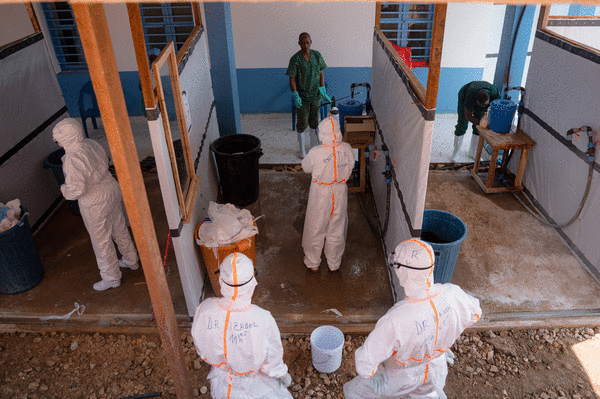
Ebola, a deadly virus, is spreading rapidly through parts of central Africa. By the time the outbreak was confirmed in mid-May, hundreds of potential cases had been identified, suggesting the strain had been circulating for months undetected. Although the U.S.’s retreat from global health initiatives isn’t directly to blame for this crisis, depleted resources are making things worse.
Ebola is difficult to contain in the best of times. Its early symptoms — fever, vomiting and diarrhea — are easily mistaken for other illnesses. Ebola’s attack on the immune system is also swift, and if it isn’t caught quickly, the virus can cause internal bleeding and organ failure.
The logistical challenges of treating Ebola are considerable. The Democratic Republic of Congo, the current epicenter, is ravaged by conflict. Millions of people have been displaced, and distrust of the government is pervasive. The sick are often reluctant to seek care. Although Congo has handled more than a dozen outbreaks since Ebola was first identified in 1976, standard protocols are often hard to implement.
The recent outbreak has been unlucky in some ways. Because test kits were developed for the more common Zaire strain, early testing repeatedly came back negative. Locals called the outbreak a “mystical disease.” It wasn’t until blood samples were transported hundreds of miles to the capital that officials confirmed the rare Bundibugyo strain was to blame. By then, the suspected case count was five times the size of a 2014 outbreak that killed more than 11,300 (including one man in the U.S.) and infected 28,600. No vaccines or treatments for Bundibugyo exist.
Normally, reports of a mysterious virus would’ve been a “hair-on-fire” moment, as one former senior global health official put it. U.S. and international aid workers would’ve been regularly communicating with local experts to speed up testing and surveillance.
Misguided decisions by the White House have slowed that response. On his first day in office, the president ordered the U.S. to withdraw from the World Health Organization and sanctioned the dismantling of foreign aid. The administration then ordered staff at the Centers for Disease Control and Prevention to cease communications with the WHO before cutting more than 2,000 workers from the agency. (Some were eventually reinstated.) The State Department is now overhauling Pepfar, the global program that fights HIV, whose labs, surveillance and staff are often mobilized for other outbreaks.
All told, U.S. foreign aid has been reduced by more than half since 2024. Although it’s hard to squarely blame these cuts for the current outbreak, weaker health surveillance hasn’t helped. Contact tracing has been slower than in the past, testing has been limited, and standard infection-control practices — for example, properly doffing protective equipment — have been unevenly implemented. The CDC has warned that absent a large-scale response, this outbreak could become one of the largest Ebola epidemics on record.
Containment will require a surge of resources, lab and surveillance equipment chief among them. Encouragingly, some funding is starting to flow. The bigger challenge will be restoring the relationships with local leaders and global partners uprooted by staffing cuts. Thanks to the WHO withdrawal, the CDC learned of the outbreak more than a week after the WHO was first notified. Suffice it to say, emergencies are hardly the time to reestablish rapport.
A cynic might ask why any of this matters to Americans. Ebola, because it spreads through close contact with bodily fluids, is unlikely to cause a global pandemic. Yet the recent outbreak isn’t happening in isolation: Public-health officials are grappling with another rare and troubling disease — hantavirus — and measles continues to circulate. The worry, as one former senior U.S. health official put it, is an outbreak that spreads like Covid-19 and kills like hantavirus. By that measure, Ebola is a warning.
The White House appears to believe that it can spend money when problems arise. Yet keeping the public safe requires the opposite approach: steady investment. The administration should recognize, before it’s too late, that experienced staff and basic resources may be the best protection against a public-health disaster.
____
The Editorial Board publishes the views of the editors across a range of national and global affairs.
©2026 Bloomberg L.P. Visit bloomberg.com/opinion. Distributed by Tribune Content Agency, LLC.
















































Comments