Gautam Mukunda: Trillionaires and republics will be a toxic mix
Published in Op Eds
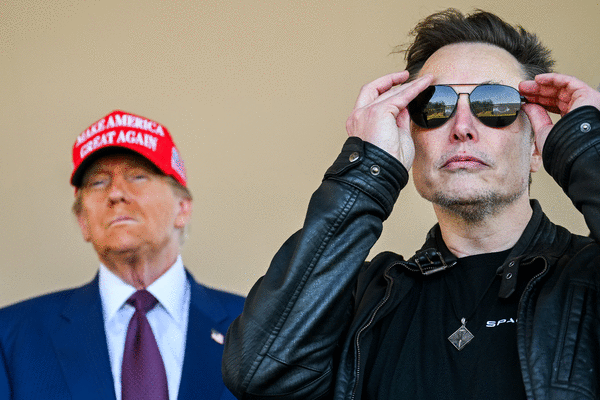
SpaceX’s initial public offering made Elon Musk the world’s first trillionaire. You might think there’s not much you can buy with a hundred (or a thousand) billion dollars that you can’t buy with one billion dollars. But there is: Absolute power.
The world’s top 10 wealthiest individuals all have fortunes of around $150 billion or more, led by Musk at $1.11 trillion, according to data compiled by Bloomberg. It takes at least $80 billion to get into the top 25.
A mega-billionaire, and certainly a trillionaire, has resources that approach or exceed those of many nation-states. To be sure, gigantic fortunes aren’t new. At his peak in 1913, John D. Rockefeller’s wealth commanded a share of the American economy similar to Musk’s today. What is new is the sheer number of people with effectively limitless resources and how easily they can convert their wealth into power.
Mega-billionaires typically employ many people. Those people often reach out to me for advice. The conversation almost always goes like this: They’ve thrived in the private sector or the military and now they’re struggling, because nothing in their new job goes the way they expected and they don’t understand what’s wrong.
I almost always say the same thing. You used to be a businessperson or a soldier but now you’re a courtier. You work for a king. You used to be judged by your ability to make a profit or win a war. Now your real job is gaining the king’s favor. It’s often tough for them to hear but they usually say something along the lines of “it all makes sense now.”
And like the kings of old, our modern-day kings don’t just have a court. Increasingly, they have a sword too. The political scientist Jeffrey Winters calls America a “civil oligarchy”: Its rich disarmed long ago, hiring lawyers instead of soldiers, because the state defends their fortunes for them. That bargain is cracking.
Sometimes the breach is direct. Via SpaceX, Musk controls one of America’s most important defense contractors. The Space Force keeps assigning launches to SpaceX that its only competitor cannot do. Musk even conducts his own foreign policy. In 2022, he personally declined to extend Starlink coverage over Crimea, stalling a planned Ukrainian strike on the Russian fleet.
In Political Science 101, a government is defined as the entity with a monopoly on the legitimate use of violence. That monopoly hasn’t broken, but it’s under more pressure than any time since Henry Clay Frick sent the Pinkertons against striking workers at Homestead in 1892.
Sometimes the breach is indirect. In 2024, six Americans each spent more than $100 million on the presidential election. Musk gave about $291 million, the most of anyone, to help boost Republicans. Timothy Mellon, heir to the Gilded Age Mellon fortune, gave more than $190 million. Casino magnate Miriam Adelson, the hedge-fund billionaire Ken Griffin, the options trader Jeff Yass, and the shipping-supplies billionaires Richard and Elizabeth Uihlein each gave more than $100 million. Both sides play the game. In 2022 the largest donor in the country was George Soros, who gave about $128 million to Democrats.
These sums dwarf what candidates can raise themselves. In Ohio, 2024’s most expensive Senate race, the campaigns raised about $113 million. Musk alone spent more than the entire field, about as casually as you’d buy a soda. His spending came to about 1% of the daily swings in his fortune. The exchange rate between wealth and power has never been so favorable. And the purchases are no longer defensive.
This is an eternal problem for republics. Marcus Crassus was the richest man in ancient Rome. So rich that, by Plutarch’s account, he thought no man truly wealthy unless he could pay an army from his own purse. He spent that fortune bankrolling Julius Caesar and building the triumvirate that sidelined the Senate and, in fact if not in name, overthrew the republic.
But one republic did win this fight. In February 1902, after President Theodore Roosevelt’s Justice Department moved to break up his railroad trust, J.P. Morgan, the most powerful financier of the age, came to the White House with an offer. “If we have done anything wrong,” he told the president, “send your man to my man and they can fix it up.” “That can’t be done,” Roosevelt replied. His attorney general, Philander Knox, finished the thought: “We don’t want to fix it up, we want to stop it.” Morgan, Roosevelt later said, “could not help regarding me as a big rival operator.” Roosevelt showed that the president was not first among equals. He is simply first, because he is the only person the whole country elects to represent it.
Even that victory was a close call. Roosevelt won his legal case against Morgan by a single Supreme Court vote, and he later needed Morgan’s help to end a coal strike that threatened to freeze the country through winter. Morgan remained powerful, but the government of the United States was supreme.
Crassus would fit right into America today. Musk funded the campaign that got Donald Trump elected as president a second time. He then worked inside the new administration, slashing agencies regulating his own companies. Economists studying the former Soviet bloc saw oligarchs graduate from bending the rules to buying them outright. They called it state capture. The American version is (mostly) legal.
Last year, the kings collided. Trump threatened to cancel Musk’s federal contracts. Musk threatened to ground the capsule NASA relies on to reach the space station. Within hours both stepped back. That’s not the rule of law; it’s two rival courts negotiating a cease-fire. No democratic government should fear the power of one of its own citizens.
Roosevelt’s refusal settled, for a century, that in America only the people are sovereign. But not forever. Musk’s trillion is a landmark of wealth. It’s also a sign that the old question has returned. In a republic, there is supposed to be exactly one thing money can’t buy. We are about to find out whether that is still true.
_____
This column reflects the personal views of the author and does not necessarily reflect the opinion of the editorial board or Bloomberg LP and its owners.
Gautam Mukunda writes about corporate management and innovation. He teaches leadership at the Yale School of Management and is the author of "Indispensable: When Leaders Really Matter."
_____
©2026 Bloomberg L.P. Visit bloomberg.com/opinion. Distributed by Tribune Content Agency, LLC.



















Comments