Trudy Rubin: Ukraine's ambassador spells out why a Kyiv-Washington partnership is so urgent
Published in Op Eds
While the United States has been focused on fighting an old-fashioned air war against Iran, Ukraine has been showing the world how to fight the new global drone war.
Despite the massive U.S. air bombardment of Iranian military and industrial sites — which still hasn’t ended the war — the Pentagon was unprepared to counter thousands of cheap, unmanned Iranian drones directed at U.S. bases and at the energy infrastructure of Arab Gulf allies.
Over the past several weeks, Arab Gulf nations and U.S. forces have been using multimillion-dollar missiles to down Iranian Shahed drones that cost $20,000 to $50,000. As the world’s leader in drone and counter-drone warfare, drawn from four years of rebuffing Russian aggression, Ukraine’s unique, battle-tested skills are now in hot demand from Europe, Saudi Arabia, Kuwait, the United Arab Emirates, and Qatar, as well as by private U.S. tech companies.
Only the White House has, so far, been inexplicably unwilling to take advantage of Ukrainian President Volodymyr Zelenskyy’s offer to share technology and testing grounds — along with the immediate sale of drones and drone interceptors to the Pentagon. Instead, President Donald Trump has sneered at the offer.
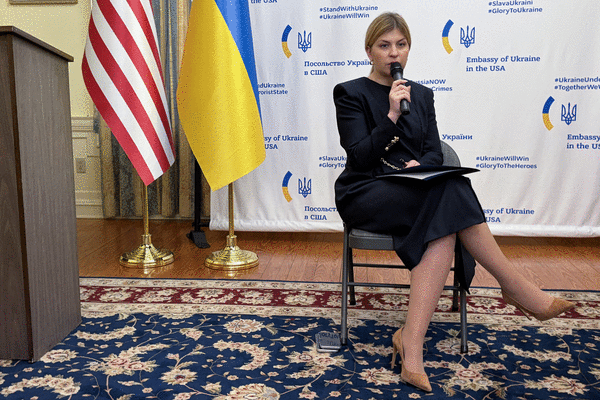
I asked Ukraine’s new ambassador, Olga Stefanishyna, about Zelenskyy’s repeated aid proposals and what help Kyiv still needs from Washington. An economist and international lawyer who led Ukraine’s negotiations on accession to the European Union, she hopes to “build a new way of relations between Ukraine and the United States in these very, let’s say, complicated times.”
We also talked about the reasons for Ukraine’s astonishing success, contrary to frequent predictions by the White House, in halting Russian military advances and withstanding the brutal Russian winter offensive aimed specifically at civilians. And what would be needed for success in stalled U.S. negotiations to end the Ukraine war.
“I’m absolutely proud of representing the nation of free, brave, and the most stoic people, I think, on the whole planet,” Stefanishyna told me, as Russia continued to slam Ukrainian cities with drones and ballistic and cruise missiles.
Indeed, vastly outnumbered Ukrainian forces held their own on the battlefield this past winter, even as Moscow tried to freeze urban dwellers to death by knocking out power and heating in subzero temperatures (forcing families to burn furniture or trees for fuel, or sleep together in parkas, under huge piles of blankets, or huddle within hiking tents in their apartments).
“We have survived through this winter, even though our own forecasts were much more negative than what occurred,” the ambassador related. “We have learned our lessons, and we will become stronger.”
“Basically, what we saw is the inability of Russia to actually achieve any of the victories on the front line that they were claiming. So they decided to demoralize the Ukrainian people and attack cities, increasing by 40% the losses among the civilian population.”
As she pointed out succinctly, “just at the point of time when U.S. negotiators were investing their time to bring the positions of the Russian aggressor and the victim, Ukraine, closer, Russia makes a choice to kill more civilians. This is anything but a diplomatic effort.”
Meantime, as Russia helps Iran with drone technology and satellite information on U.S. targets, Kyiv is trying to help American troops on the battlefield. Stefanishyna envisions a reciprocal partnership with Washington, in which each side can provide the other with critical assistance.
Under Trump, the U.S. has ceased providing any military or economic aid to Ukraine. Vice President JD Vance shamefully called the end of Ukraine aid “one of the proudest” achievements of the Trump administration. Instead, a system known as PURL has been established, whereby NATO and Europe fund weapons purchases urgently needed by Ukraine, such as Patriot missiles (which can shoot down Russian ballistic or cruise missiles that target cities).
“The PURL mechanism has not been disrupted,” said Stefanishyna, “but, of course, when speaking about implementation of future procurement plans … U.S. military needs might change.” Already, the U.S. is diverting Patriot missiles to the Mideast; Gulf allies have already used up a year’s worth of U.S. production of the missiles defending themselves from Iran, using these $2 million weapons to shoot down $20,000 drones.
Two mutually beneficial actions are urgently needed from Washington, the ambassador suggested. First, “there is a huge potential to scale up the capacity and military production of the United States,” she said, “and if political reality requires, it should be done.” Indeed, Trump himself said this is a goal. Patriot missiles, which are vitally needed by the U.S., European, Gulf, and Taiwanese — and Ukrainian — militaries, should top the list.
Second, the U.S. must grasp that military reality has changed forever, and “this reality is now being formed, unfortunately, on the battlefield in Ukraine.”
“Basically, there is only one nation on the entire planet that can effectively counter this threat in any part of the world. We can offer real action now, not just political statements, but real security for civilians and for people in cities,” said Stefanishyna.
Since the Iran war began, Gulf nations have been clamoring for Ukrainian assistance, and Kyiv has sent more than 200 experts to the region. As multiple world powers invest heavily in Ukrainian expertise and joint production with the Ukrainian government and private companies, only the Pentagon is holding back. And it shows.
When the U.S. military deployed its new, cheap LUCAS attack drone to the Iranian front, the number was reportedly in the dozens. Ukraine produced four million drones last year and is aiming for seven million this year. Iran also churns out massive numbers of drones, as does Russia.
However, Stefanishyna pointed out something very important. “We have been advocating for a drone deal with the United States, but even though it’s not being formalized, it’s already happening. We have more than 100 U.S. investors who have already expressed interest in Ukrainian defense tech companies.”
A couple of examples of private U.S.-Ukraine cooperation: The Merops anti-drone system, backed by former Google CEO Eric Schmidt, was battle-tested in Ukraine; a small number of them were sent to the Iranian front. Also, American defense technology company Anduril Industries just announced a strategic partnership with the Ukrainian drone detection and electronic warfare firm Kara Dag Technologies.
“The United States is the pioneer and front-runner of economic innovation and has to be the front-runner of this innovation,” said Stefanishyna, “and Ukraine has made a commitment to contribute to that.”
Instead of dissing Ukraine and pressing Kyiv to give up territory to the Russian aggressor, the Trump administration should be welcoming the mutually profitable military and economic cooperation (including minerals) that Zelenskyy is offering. More Patriots (paid for by PURL) to Ukraine, drone interceptors to the Pentagon, and encouragement for private deals.
And, I’d add, before restarting “peace talks,” White House recognition that Ukraine is a valuable ally, while Russia wishes us ill.
_____
_____
©2026 The Philadelphia Inquirer, LLC. Visit at inquirer.com. Distributed by Tribune Content Agency, LLC.


















































Comments