Once dormant, Chicago's weather bell is aglow once again
Published in Lifestyles
CHICAGO -- Cities are ever-changing organisms, shedding elements of the past while retaining others. Striking the right balance is the challenge, and it’s easy to feel cynical about the moneyed interests driving so many changes that remove, bit by bit, the idiosyncrasies of our surroundings.
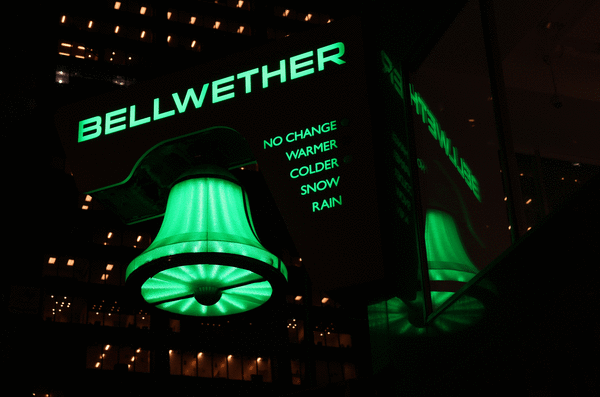
Which is why it’s a pleasant surprise to learn that the office-to-residential conversion underway at the Rector Building in the Loop includes the restoration and repair of the weather bell affixed to its second story at the southeast corner of Clark and Monroe streets.
The weather bell’s very existence might spark a puzzled glance or two from anyone unfamiliar with it.
Non-functional for at least a decade, if not longer, it once provided a simple forecast. When lit up red, the thermometer was expected to rise. When yellow, temperatures were expected to drop. And when green, conditions remained unchanged. The bell’s color would flash if rain or snow were imminent.
Now, after a prolonged dormant period, the weather bell is aglow once again.
“The bell was in pretty rough shape,” said Gary Stoltz, the chief design and development officer at the private equity real estate firm R2, which is redeveloping the building. “It’s acrylic with stainless steel accents, and then you have the metal panel that kind of clads the armature. All of that was in some form of disrepair and, aesthetically, it didn’t represent what we wanted to do with the building.”
Something needed to be done.
A pessimist might wonder if they considered getting rid of the bell altogether, instead of spending money to restore it to working condition. After all, the bell is a non-monetizable adornment, and you can picture someone deciding it’s more trouble than it’s worth.
But according to Stoltz, “I think it would have cost more to take the bell down and then do repairs to the façade behind it.”
Also, “if we wanted to maximize profits, we would not be converting and adapting an office building into residential. It’s not an excellent way for the owners to make money; building new would have been less expensive. But this is absolutely necessary for Chicago’s future. We’ve been working on it for four years and two mayoral administrations; you basically have to convince their teams why this is important.”
The bell itself is integral to the building’s former identity (more on that in a moment), but also its future identity, complete with a new name: The Bellweather.
“We usually go through a rebranding process, or at least try to understand a building’s history,” said Stoltz.
In this case, it is a history dotted with footnotes.
The high-rise was built in 1905 by the restaurateur Charles E. Rector and it is “one of the oldest surviving examples of early commercial high rises designed by architect Jarvis Hunt,” combining “classical design features with aspects of 20th century modernism from the Chicago and Prairie Schools,” according to Preservation Chicago’s website.
Rector himself fought in the Civil War for the Union. After gaining early food service experience working in railroad dining cars, he eventually came to Chicago, where he first opened a luxurious (if temporary) restaurant at the World’s Columbian Exposition in 1893 called Café de la Marine, which specialized in “all animals from water,” according to one guidebook.
In 1884, Rector opened an oyster house at Clark and Monroe — the future site of a much larger building to come — and it became notable enough that it shows up in Theodore Dreiser’s 1900 novel “Sister Carrie,” when a character dines at Rector’s, a restaurant “of some local fame, which occupied a basement at Clark and Monroe Streets.” With its “polished marble walls and floor, its profusion of lights, its show of china and silverware, and, above all, its reputation as a resort for actors and professional men, (it) seemed to him the proper place for a successful man to go.”
Originally, there was no weather bell. That wouldn’t be added until a half century later in 1951, when the Rector Building became the headquarters for Bell Federal Savings and Loan, a bank founded by the employees of Illinois Bell Telephone. The bank occupied offices in the building until 1997.
Ornamentally, many financial institutions of the 20th century distinguished themselves with a public clock as part of the building. It seems that decision-makers at Bell Federal decided to take that idea a step further with the installation of the weather bell.
The bank was an alternative to the more starchy, white-collar financial institutions up and down Monroe and Clark and LaSalle streets, and “it must have appeared that perhaps Bell Federal Savings was sending a message,” said Ward Miller, the executive director of Preservation Chicago. “The idea might have been that they were a little more contemporary, hip and fresh versus the solid and traditional banking building across the street with its large analog bronze clocks.”
Miller is referring to the original First National Bank building at Dearborn and Monroe, a contemporary of the Rector Building designed by Daniel Burnham and torn down in 1970.
“We almost forget now that Monroe Street was a big financial powerhouse,” he said. “But there have been so many changes — demolitions but also consolidations of banks — that you don’t get that same feeling that you used to get when you looked down Monroe Street, when there were a whole slew of bank buildings.”
Bell Federal itself was acquired by another bank in 1977, the first of many times the bank has been sold in the years since.
The choice for the bell was intuitive, going back to the logo for Illinois Bell (now owned by AT&T), which featured, yes, a bell.
“This electronic flashing bell would have really distinguished the location in this darkened canyon of buildings at the time,” said Ward. “And then in the 1960s and 1970s, if you looked down the street, you would have seen the Italian Village neon sign sticking out in the same view as the weather bell. And if you looked further down, there was the Monroe Theatre, with its flashing marquee. And if you looked down Clark to Madison, you would have seen the Clark Theatre with its marquee and flashing lights. So the bell was competing not only with the bronze clock of First National Bank, but it was also competing with these theater marquees and these restaurants. The Loop was more than just big banking operations and office buildings, and the Rector Building was on this border between the financial district and the restaurant-entertainment district that we sort of forget about now because so much of that has been sanitized and demolished and removed.”
But the bell remains.
“If you talk to anyone in Chicago and you say the building with the weather bell, they know it,” said Stoltz. “So from a history and branding perspective, the weather bell was a really important part for us. Yes, it was less money to rehab it than to remove it, but also it’s a selling point. It’s something people talk about. Anyone who has experience in the Loop, it means something to them. It’s a landmark.”
Plus, “everyone knew it wasn’t necessarily accurate, but that was part of its charm.”
That’s because it used to be controlled manually, relying on a human being to stay alert to changes in the forecast. “There’s a dial in the basement and you just turn to what the weather is. But now it’ll be completely digital.” There is a time and temperature display (using information provided by a local weather station), and they’ve also installed a mini-weather station on the underside of the bell itself, which will determine which color is displayed.
Unlike public clocks, a weather bell is a rarity.
According to Miller, there was, at one time, a branch of Bell Federal Savings on Michigan Avenue and Water Street. “Right at the corner, they had a two-panel sign which was the outline of a weather bell, and it had the same color-coding for the forecast.”
But that was a two-dimensional sign, unlike the one at Clark and Monroe, which makes the latter unique and special.
And yet, when the Rector Building recently received landmark designation from the city, the weather bell was not included. According to Ward, it’s not clear why. In theory, it should be safe for as long as the building is branding itself as the Bellweather, but could be in jeopardy at some future point if an owner chooses to get rid of it.
“The landmarking is a local designation and usually concerns itself only with the exterior of the building,” Stoltz said. But the developers have sought historic preservation tax credits, and on the federal level (which is overseen by the National Park Service), the government agency “looks at everything. And so they opined on how we were rehabbing the building … and we had to renovate the bell to their standards, which basically means replacing it in kind. More or less, other than the change in the name, it will look almost identical to what it looked like originally.”
Here’s hoping it’s here to stay for decades to come.
Being such a unique structure, how did R2 figure out who would know how to fix the bell and get it working again? “That took a while,” said Stoltz with a laugh.
“It was cracked, and it has custom-molded acrylic panels. We couldn’t find anybody to reproduce that, so one of the panels has been repaired. It’s on a side that isn’t very exposed, so hopefully not a lot of people will notice it. And then we had to clean the acrylic, because it had 50 years of gunk on it. I don’t think a lot of people knew that the bell was translucent and glowed, just because it’s been dirty for so long, it almost looked solid.”
We tend to form emotional connections with the quirks and peculiarities that help define our surroundings. When they endure over time, they create a link to the lives that lived here before us. The weather bell is an invitation to look up from the bubble of our phones and engage with the world around us. Here is a building interacting with — and reflecting — its environment.
For many years, the Loop has felt emptied of life at the end of the workday, and there have been recent efforts to restore a sense of vibrancy even in the evening hours. A weather bell illuminated 24 hours a day, seven days a week, will likely contribute to that. “It’s close to street level and the fact that it’s going to be a bright color at all times, you can’t miss it,” Stoltz said.
“We didn’t think we would get this kind of response; we just thought it would be a good idea. We’ve had a lot of folks tell us that this held a special place in their memory of the city, and I think that will happen again.
“I grew up in the western suburbs,” said Stoltz, “but I was familiar with it from working downtown, so I walked by it regularly. I’ve lived in the South Loop for over 20 years, so I pass by it frequently.”
It may not have official landmark status, but it is a landmark all the same.
©2026 Chicago Tribune. Visit at chicagotribune.com. Distributed by Tribune Content Agency, LLC.





















Comments