Kyle MacLachlan analyzes his 'Fictional Selves' in new memoir
Published in Books News
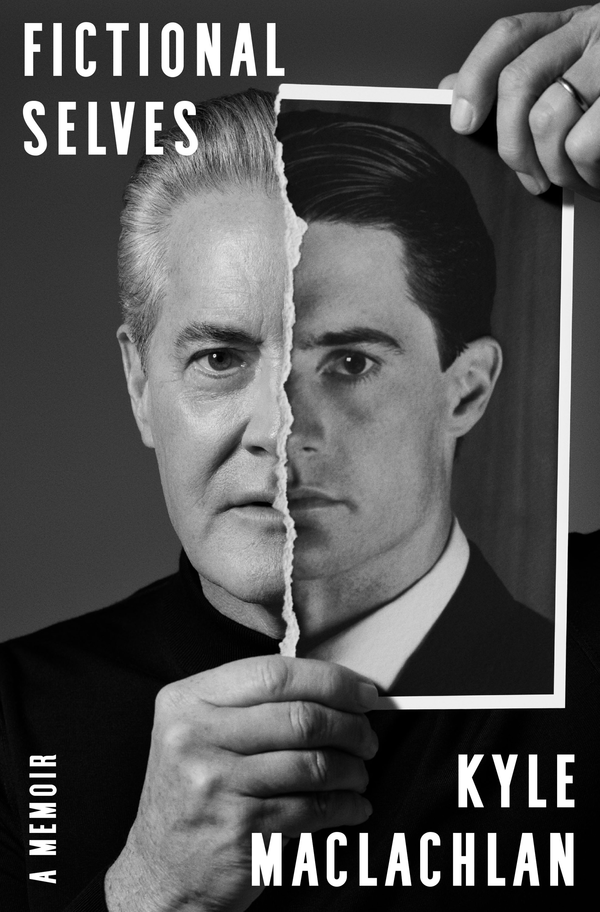
SEATTLE — In decades of performing, beginning as a University of Washington student and encompassing iconic roles in film (“Dune,” “Blue Velvet”) and television (“Twin Peaks,” “Sex and the City,” “Desperate Housewives”), Kyle MacLachlan has entertained a vast audience. His new memoir, “Fictional Selves” (out Sept. 29 from Crown), however, was written primarily for an audience of one.
The Yakima-born actor — on a friendly phone call from his home in Los Angeles — said that years ago, he was asked by the literary manager at his talent agency about writing a memoir. He immediately said no. “Why would I want to do that?” he remembered. But more recently, the question came up again, and the answer felt different.
“It wasn’t that I was so different, but I think a couple of things in my life had changed,” he said. The key factor, he said, was his son Callum, now in his teens. MacLachlan liked the idea of “letting him know who his dad was and where he came from, and some of the history.” The actor’s own father died 15 years ago, and MacLachlan regrets the questions he didn’t ask: “I really wish I could dig into what his life was like when he was younger, how he was formed … So part of it was a looking back, and also the idea of looking forward and what it might mean to (Callum) in the future.”
He was also motivated by “a desire to tell the real story, as much as you can in a memoir … things that I struggled with, decisions I made that were not good. This was behavior that wasn’t great behavior, but out of that came some lessons.” MacLachlan’s life as an actor has encompassed much success, but it’s also come with setbacks. “It’s more interesting to see the struggle,” he said, “to see where you fell and how you picked yourself up again, and how you kept going.”
Created in collaboration with writer Jon Sternfeld, “Fictional Selves” isn’t entirely chronological, as a typical memoir might be. “I don’t want to start ‘I was born Feb. 22, 1959, at Memorial Hospital, Yakima, Washington, blah blah blah.’ I’d rather cut to the chase … just jump in to what was one of the momentous, monumental moments in my life.”
That moment, more than four decades ago, was David Lynch’s “Dune.” MacLachlan was then a 24-year-old working actor living in a tiny studio apartment in the University District and spending evenings drinking with friends at the Comet Tavern on Capitol Hill, after rehearsals at the Empty Space. He was just six months out of UW’s Professional Actor Training Program, and had virtually no experience acting for a camera. Nonetheless, after a trip to Los Angeles and a screen test with a kind and encouraging Lynch (“In his simple, albeit mystical way, he gives me the confidence to get through it”), he was awarded the lead role of Paul Atreides in Lynch’s highly anticipated adaptation of Frank Herbert’s blockbuster novel.
It was an astonishing, starmaking break for a young actor, and it came with what appeared to be a ready-made career: a splashy debut in cinemas around the world, options signed for multiple sequels, gigantic posters of MacLachlan hanging in Times Square. During the long wait between the film’s seven-month shoot in Mexico and its release in December 1984, MacLachlan imagined how his life would change: He could, perhaps, keep living in Seattle, and work in films whenever and however he wanted to, riding the crest of “Dune” fame.
But reality crashed quickly: The film was famously a box-office flop, the sequels were canceled and MacLachlan’s phone was silent. The Hollywood future he’d been promised instantly disappeared. In retrospect, MacLachlan said, it was probably for the best. “I honestly don’t think I was ready,” he said. “I don’t think I was ready as an actor, I don’t think I was ready emotionally.”
“Fictional Selves” takes us through that journey with young MacLachlan, who found his footing as a screen actor soon afterward with Lynch’s “Blue Velvet” and then in television with the director’s “Twin Peaks.” One of the book’s many pleasures is its portrayal of Lynch, who speaks in a relaxed all-capitals drawl and made on his sets an atmosphere of trust and creativity. “David creates these worlds, brings them to life and takes a step into them,” MacLachlan wrote. “Then he reaches out and brings you in with him. In that environment, things come together like magic.”
MacLachlan, who frequently visits the Seattle area (his two brothers live nearby), laughed when told that the North Bend diner that served as a set for “Twin Peaks” is still, to this day, filled with Dale Cooper and Laura Palmer look-alikes. “I’m too scared to go into the diner,” he said. “I’ve driven by a few times, and I’ve even popped out to take a picture, kind of down the block.” Asked why he thinks the show still has such a hold on its fans after so many years, he cited Lynch’s world-building. “There’s something about just being in that space, that people are drawn to … They like the vibe of it. You could point to David; he loved the world of ‘Twin Peaks’ so much, he wrote (the character of) Gordon Cole into the show so he could be part of ‘Twin Peaks.’”
Lynch, who died in 2025, had “such a profound impact on my career, and on my life, and on the way I look at the world now,” MacLachlan said. “We had a beautiful friendship.”
There’s much more in “Fictional Selves,” and “Sex and the City” fans will particularly enjoy reading his stories of playing Trey MacDougal. (Upon being pitched the role — the good news is that Trey is a handsome, debonair doctor; the bad news is that he’s impotent and has an unconventional attachment to his mother — MacLachlan almost passed, but his then-girlfriend Desiree Gruber, now his wife of nearly 25 years, urged him to take it.) But the real treasure in this book is getting inside the head of a thoughtful working actor, learning the craft alongside him as he analyzes his many roles. And he’s not yet done. He’s recently filmed the third season of the Prime series “Fallout” and the horror film “Altar,” and still dreams of landing a role as an action hero someday. “I really so enjoy watching those kinds of shows.”
A persona who frequently appears in the book is Other Kyle — “My double. My spitting image. My doppelgänger” — the screen version of the real-life man, who always knows what to say, who doesn’t age, who lives forever. “Where does this guy — this Kyle MacLachlan — end, and where do I begin?” MacLachlan wonders in the book. “And is he even real?”
Other Kyle, MacLachlan says now, would be mostly happy with the book. “I think he recognizes first that I am opening myself up in certain places and certain experiences, where I’m less than my best self. He likes that, being uncomfortable like that. He digs that, a lot. … He keeps pushing me to go further.”
©2026 The Seattle Times. Visit seattletimes.com. Distributed by Tribune Content Agency, LLC.




Comments