Column: Historian brings us more discoveries about a famous Chicago cemetery
Published in Books News
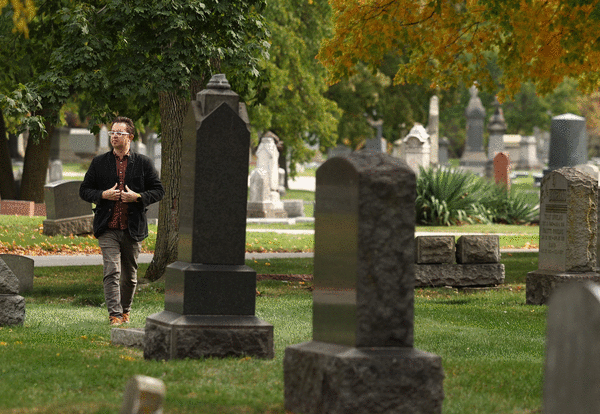
CHICAGO -- Of all the details, stories and praise that accompanied the recent death of Dolly Parton, one of the most surprising was her affection for cemeteries.
We learned that she once said, “I love cemeteries … because nobody but weirdos like me really want to hang out there. I don’t go there just to hang out with the dead; the dead don’t scare me though, it’s the living that’s got me frightened.”
She’s got a good point there, as with most of her observations, but I’d argue with her about cemeteries attracting “weirdos.” I love the places and certainly don’t think of myself as a weirdo. I don’t think of Adam Selzer as one either.
I think of this man as a historian, writer and tour guide. He is a native of Des Moines who spent time and college years near Atlanta before coming here, where he began working for a ghost tour operation and writing young adult fiction.
Some years ago he told me, “I loved giving ghost tours but some of the stories I was telling people sounded fishy to me so I started doing further research to make things not only more accurate but entertaining. I never tried to trick people.”
So he was drawn to musty libraries, archives and the internet. And to cemeteries. Like Parton and me and many others, he was exhibiting a condition with a scientific name, taphophilia, a word of Greek origin defined as “a love of funerals, cemeteries and the rituals of death.”
Selzer has been at it for some time. Four years ago he published a spectacular book, “Graceland Cemetery: Chicago Stories, Symbols, and Secrets” (3 Fields Books, an imprint of the University of Illinois Press). In it he wrote, “Taken as a whole, these stories at Graceland present a unique lens through which to view American history. And there’s always more to find.” And both books are easy to use as walking guides.
His latest discoveries are between the covers of his new “Graceland Cemetery Vol. 2.” He admits that his challenge was “that most of the famous monuments were already covered in depth in Volume 1. Only a few of the people in Volume 2 have graves marked by the sort of statues or monuments that inspire urban legends all on their own, and just a handful are people with names that would bring a spark of recognition to many Chicagoans today.”
That’s just fine, because it has allowed him and readers the chance to experience the jolt of discovery by “meeting” such people as William Bradshaw Egan “a Falstaffian character who was known to everyone in town and played many critical roles in building the city”; Celia Wallace, “The Diamond Queen”; and Mary Baker, “the vanishing bride of the 1920s.” And to learn new things about artist Ed Paschke, show biz mogul Florenz Ziegfeld Jr., and athletes Minnie Miñoso and Doug Buffone.
A few people who appeared in the first volume reappear here, their stories embellished by new facts. As Selzer says, “everyone has a story and I’ve discovered that some people have lots of stories.”
One of the things that distinguishes Selzer’s work is his stylish writing. It’s there in his 2017 book, “H.H. Holmes: The True History of the White City Devil,” and in both Graceland books.
I knew many of the people in this new book and was happy to learn some new things about them.
There is Win Stracke, about whom Selzer writes, in part, “In November 1946, the Chicago Star advertised a remarkable lineup of folksingers appearing at the home of Ruth Kaplan on West Wellington: Lead Belly, Woody Guthrie and Win Stracke. Chicago’s own Winfred Stracke (1908-1991) may have seemed out of place among them. … Stracke was a refined basso singer who usually wore a suit and tie; Studs Terkel said he looked like a banker. Lead Belly and Guthrie would soon be known as legends.”
And then I found Ed Uhlir, who was a friend, and learned that, as Selzer writes in part, “Parks had long been a passion for Uhlir; at 17 he published an editorial on ‘The Lost Art of Walking’ in the Tribune. ‘To be happy and healthy, walk, don’t ride,’ he wrote. ‘Walk, whether it be to the corner drugstore or up a mountain.’ … In the 1990s, Mayor Daley made Uhlir the project manager for Millennium Park, the man responsible for hiring artists and landscapers, as well as handling the pushes and pulls from donors. When there was a question of what images could go on the Crown Fountains over time, he said, ‘We’re not going to put corporate images up there, I can promise you that. It will always be art.'”
This is a busy time for Selzer, with more tours, more Halloween-related activities. He has always given tours of other cemeteries. He is working on a couple of new book projects. There is some talk of his having a radio show or podcast. For the moment, though, his heart and head are at Graceland. As he says, “There are some 175,000 bodies there, and that makes for a lot of stories.”
©2026 Chicago Tribune. Visit at chicagotribune.com. Distributed by Tribune Content Agency, LLC.







Comments