As LIRR strike enters first day, New Yorkers face shutdown, brace for rush-hour chaos
Published in News & Features
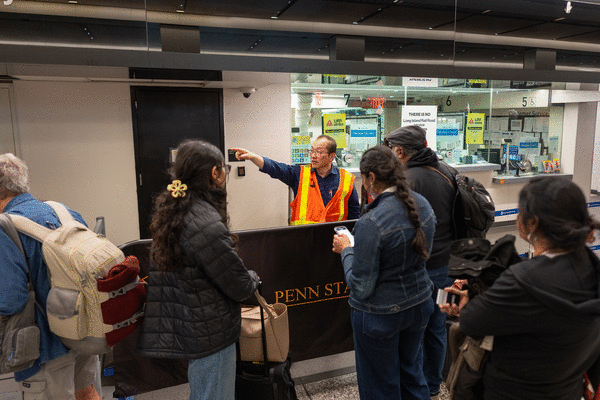
NEW YORK — New Yorkers braced themselves for chaotic commutes not seen in three decades as the Long Island Rail Road strike entered its first day on Saturday — with some already feeling the sting from the collapsed contract talks between railway workers and the MTA.
Walking through Penn Station with the aid of crutches, Long Island psychologist Steve Vaccaro tried to enter the Long Island Rail Road, only to be greeted by something he’s never seen before: signs reading “No Passengers” and “Service Suspended.”
Vaccaro, 61, had been in Florida and was rushing to Merrick to promote a spina bifida fundraiser on his radio show. Saturday’s LIRR strike left him blindsided without a way to get home, he said.
“I’m totally baffled, totally floored,” Vaccaro told the Daily News Saturday. “I didn’t expect there to be a strike.”
“This really, definitely affected me,” said the psychologist, who flew into Newark Liberty International Airport and took the PATH train to Penn Station, hoping to link up with the LIRR. “When you’re out of New York, everything’s a little more peaceful, and then when you come back, you know there’s always something — drama.”
As he tried to figure out a way to get to Long Island by 6 p.m. Vaccaro wanted to kick himself for flying into Newark.
“If I would’ve flown into JFK or LaGuardia, I’d be closer to have someone pick me up,” he said, trying to figure out who to call for help. “I hate bothering people, especially on a Saturday. I could ask a friend or two but most of them are in Suffolk County, so it’s a trek.”
“I’m not gonna take an Uber,” he said, “they’re gonna charge me $200.”
Vaccaro was just one commuter left idling over how to navigate the LIRR strike, which went into effect at 12:01 a.m. Saturday after ongoing contract negotiations between workers and the MTA broke down and 3,500 railroad employees walked off the job.
LIRR service was immediately “suspended until further notice,” the MTA said early Saturday.
“Avoid nonessential travel and work from home if possible,” the MTA advised on X. “We will have limited shuttle bus service on weekdays for essential workers and those who cannot telecommute.”
Gilman Lang, general chairman of the Brotherhood of Locomotive Engineers and Trainmen, indicated in a statement early Saturday morning that this strike could stretch longer.
“This is an open-ended strike,” he said. “We don’t know when it will end.”
The strike is expected to be a nightmare for the 300,000 commuters who rely on LIRR trains to get them in and out of the Big Apple each day. The contingency plan relies heavily on shuttle buses, but MTA officials admit it won’t come close to moving the number of people who rely on the trains.
It was the first time a strike has stopped the Long Island Rail Road in 32 years, when rail workers walked off the job for two days.
Over at Long Island MacArthur Airport, in Ronkonkoma, long lines formed at airport rental car locations as travelers tried to figure out how to get home.
“There’s no eta for a car…20 people waiting behind me,” X poster@UhhSimmaSimma wrote Saturday. “The burden of greed by both sides effect (sic) the paying customers. More money, time & stress.”
Meanwhile, people driving on the Long Island Expressway were greeted by digital signs reading, “LIRR Strike in Effect. Expect Heavy Delays.”
Long Island baseball fans were among the first to be affected by the railroad strike as they tried to figure out how to get to Citi Field for — ironically — the ongoing subway series between the Mets and Yankees.
The Mets took the bold step to organize shuttle services from several Long Island locations, including Roosevelt Field, to help get fans to the stadium on Saturday.
Mayor Zohran Mamdani warned that New Yorkers “should prepare for heavier-than-usual traffic, crowded transit options and additional travel time” as Monday approaches.
“We are continuing to closely monitor the ongoing contract negotiations involving the LIRR,” the mayor wrote on X. ”City Hall and agencies across the administration are actively coordinating preparedness and contingency efforts to help maintain continuity for commuters and support New Yorkers as conditions evolve.”
Striking LIRR workers set up picket lines at Penn Station and Ronkonkoma Station in Suffolk County. Other picket lines were likely to be formed throughout the weekend.
Outside Penn Station on Seventh Avenue at 33rd Street, about 75 LIRR workers marched up and down the block, holding signs and chanting, “What do we want? Contracts!”
“We don’t want to be in this position, because we get to know a lot of our passengers as we bring them back and forth into the city and out to Long Island every day safely,” Darryl Baldwin, 52, a striking LIRR locomotive engineer, told The News. “A lot of the passengers are our friends, our family — and it’s not a win-win situation for either part.”
“We’ll see what happens tomorrow when the union and the MTA sit down and hopefully we can make some progress here,” he said optimistically.
It was not immediately clear exactly when contract talks between the MTA and a consortium of train workers labor unions will resume.
“If this rides out into Monday, there will be real potential for chaos on our trains,” Queens Borough President Donovan Richards told WABC Eyewitness News Saturday. He noted that the Jamaica station, where the LIRR links up with NYC Transit trains, is the “fourth busiest hub in the country,” with thousands of commuters traveling through it every day.
“I’m really concerned about the impacts of this strike,” Richards said. “I’m worried at what the subways will look like and the buses will look like if they don’t increase resources.”
“From thousands of teachers, nurses and other essential workers who drive our city being forced to stay home, to thousands more cramming onto our buses, subways and streets, this strike will undoubtedly cause chaos and immediately prove to be untenable,” he said in a statement also released Saturday. “At the same time, eastern Queens residents from Little Neck to Laurelton who live miles from the subway will be left essentially stranded in their communities without efficient means of public transportation.”
Gov. Kathy Hochul called on both sides to return to the bargaining table and hammer out an agreement as soon as possible.
“I believe a deal can be done and I urge both the MTA and these unions to return to the table and bargain nonstop until a deal is reached,” she said in a statement.
Saturday’s strike comes after more than two years of contract negotiations, two federal mediation boards and — most recently — two weeks of talks that failed to find common ground on the lone outstanding issue: how much the members of five LIRR trade unions can expect to be paid.
Both sides ultimately found their way to an agreement on back-pay, with a handshake agreement to retroactively raise wages by 3% for 2023, 3% for 2024, and 3.5% for 2025.
But the labor consortium — made up of the Brotherhood of Locomotive Engineers and Trainmen, the International Brotherhood of Electrical Workers, the Brotherhood of Railroad Signalmen, the International Association of Machinists and Aerospace Workers, and the Transportation Communications Union — demanded a 5% raise for 2026, which they said was necessary to keep up with inflation.
After initially refusing to go above 3% without further concessions from the unions on overtime work rules, MTA leadership ultimately offered the unions 3% plus a lump-sum payment for the difference between a 3% raise and one year of pay at 4.5%.
The unions — negotiating a contract that was already three years behind schedule — argued that such a lump sum would only cover one year, regardless of how long a future contract took to negotiate.
MTA Chairman and CEO Janno Lieber stood his ground Saturday, saying that the authority “cannot responsibly make a deal that implodes MTA’s budget.”
“We refuse to make a deal that puts it on riders and taxpayers to fund outsized wage increases — far beyond what anyone else at the MTA is getting — and for folks who are already the highest-paid railroad workers in the country.”
Lieber said the striking unions “always wanted to strike,” and planned to use frustrated commuters as leverage to get the raises they wanted.
The MTA in its last offer, he said, “literally gave them everything they said they wanted in terms of pay but they rejected even that.”
“Their strategy,” he added, “is to inconvenience Long Islanders and try to force the MTA and the state to do a bad deal.”
©2026 New York Daily News. Visit nydailynews.com. Distributed by Tribune Content Agency, LLC.





Comments