China says it will cut levies, expand farm trade after talks with US
Published in News & Features
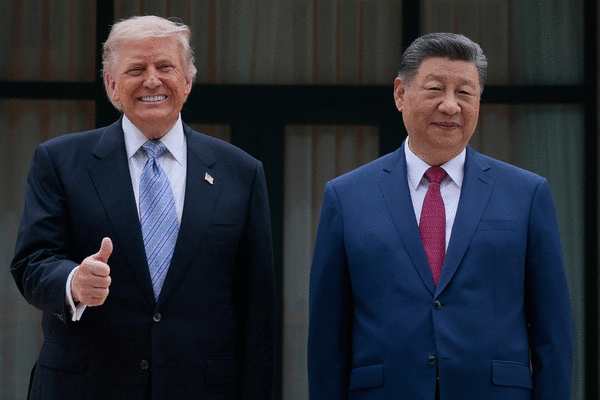
China said it agreed with the U.S. to lower levies on some products to promote bilateral trade, underscoring how ties between the world’s two largest economies are further stabilizing after the historic meeting of the leaders.
China’s Ministry of Commerce on Saturday issued an update on bilateral trade talks following a two-day summit in Beijing between U.S. President Donald Trump and Chinese leader Xi Jinping.
The ministry said Beijing and Washington will adopt a series of measures, including mutually cutting levies on certain products, to expand bilateral trade in areas including agriculture. It didn’t provide more specifics, adding that both teams are still currently negotiating over the details.
The outcome shows that both countries “can find solutions to the problems through dialog and cooperation,” the Commerce Ministry said, noting the terms were discussed during trade talks in South Korea ahead of Xi’s meeting with Trump.
Trump wrapped up his trip to Beijing on Friday, in the first visit to China by a U.S. president in nearly a decade. Both leaders struck a positive tone on U.S.-China relations but also discussed contentious issues ranging from trade to Taiwan to the Iran war.
Trump had suggested that tariffs didn’t come up in his meetings with Xi.
“We didn’t discuss tariffs,” Trump told reporters Friday aboard Air Force One. “They’re paying substantial tariffs, but we didn’t discuss.”
Bloomberg Economics, in a report issued Friday, said it remains unclear where tariffs will land. If the U.S. follows through on its stated intent to reimpose the previous reciprocal rates, “China would see an increase of about 10% in its tariff rate, which could prompt retaliation.”
The Chinese statement confirmed plans to purchase U.S. planes without providing a number or the brand. Larry Culp, the chief executive of GE Aerospace, and Kelly Ortberg, the CEO of Boeing Co., traveled with Trump to the summit in Beijing and met with state officials there.
Trump said during a television interview appearance that China would buy 200 “big” aircraft, which was confirmed by Boeing. China was expected to buy as many as 500 737 Max jets.
China also said it would actively address U.S. concerns on import licenses for its beef plants, as well as issues related to poultry imports from certain U.S. states. Bloomberg previously reported that China has renewed import licenses for hundreds of U.S. beef plants to revive the meat trade.
The Commerce Ministry reiterated that the two sides agreed to establish boards of investment and trade to discuss concerns. U.S. Trade Representative Jamieson Greer said earlier that the two sides had discussed creating a “Board of Trade” that would see tariffs reduced on at least $30 billion in noncritical goods.
One example offered by Treasury Secretary Scott Bessent was fireworks, which he said were the kinds of “very low-end consumer goods that are going to keep coming from China no matter what.”
China added the U.S. will address Beijing’s concerns on the automatic detention of dairy and aquatic products from China, the export of potted plants to the U.S., and the designation of Shandong as a Highly Pathogenic Avian Influenza-free zone.
The U.S. Food and Drug Administration currently detains dairy products from China due to the presence of melamine substances, and some aquatic products due to unapproved drugs. That essentially means the products will be refused entry unless importers can prove their case.
———
(With assistance from Felix Tam, Qianwei Zhang and Rebecca Smith.)
©2026 Bloomberg L.P. Visit bloomberg.com. Distributed by Tribune Content Agency, LLC.





Comments