Ford posts double-digit percentage sales drop in July
Published in Business News
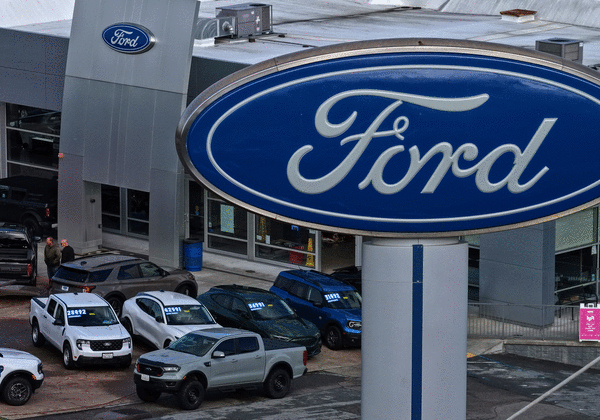
DETROIT — Ford Motor Co. reported a more than 10% decrease in U.S. sales year-over-year for July from the impacts of the Escape crossover's cancellation and continued weakness in F-Series inventory due to an aluminum shortage.
But the Dearborn automaker's U.S. sales director said the "decline is by design." Although the absence of the compact SUV from its lineup will continue, aluminum supplier Novelis Inc. in June restarted production at its hot mill that had been taken out of commission by multiple fires last fall. Plus, executives said last week during earnings they aren't seeing weaknesses in demand for high-margin trucks, SUVs and off-road trims.
"Our July results," said Rob Kaffl, Ford's head of U.S. sales, "reflect a strategy that is working exactly as planned: we've intentionally been sunsetting select models and pulled back on low-margin rental fleet volume to make room for an onslaught of new-product introductions by the end of the decade."
Ford has said nearly all of its models will have a hybrid or multi-energy powertrain choice by the end of the decade. It will launch five new affordable vehicles by then, four of which will be U.S.-assembled. The first is the all-electric midsize truck, expected to start at $30,000, based off Ford's next-generation Universal Electric Vehicle Platform.
Limited F-Series production prompted Ford to prioritize retail sales, and inventory was at a lean 45 days of supply last week. That contributed to a 96% decline in daily rental fleet sales for the month, but Ford's retail share remained about flat, Kaffl said. Excluding the discontinuation of Escape and sibling Lincoln Corsair and the planned rental pullback, sales would've been down less than 1%, outperforming the industry, he noted.
Ford sold under just shy of 170,000 vehicles last month — 169,951. F-Series trucks fell 6.5%, though the nameplate remains on track to secure a 50th year of truck leadership, Kaffl said. The midsize Ranger was down 2.5%, but the even smaller Maverick jumped 29%. The Transit commercial van was down 3.8%, including a 32% decrease for its all-electric version.
Sales of the electric Mustang Mach-E SUV dropped 65% following the end of federal tax incentives for plug-in vehicles last fall. Benefitted by some movers from Escape, Bronco Sport grew almost 11%, but the bigger Bronco was down 5.2%. Explorer saw minimal uptick, and Expedition sales fell 23%. The Mustang coupe dropped almost 20%, but through year-to-date it holds a majority of the non-premium sports car segment, Kaffl noted.
He also highlighted that entry-level trim series for Maverick, Bronco Sport and Ranger were up a combined 10.4% through July, and cash-cow off-road performance trims across its lineup were up 4.8%, representing a quarter of sales.
Lincoln brand sales were down almost 36% with all models seeing declines led by the Navigator at 32%. The Aviator and Nautilus both posted decreases of almost 3%.
"We are trading a small amount of near-term volume today," Kaffl said, "for what comes next: an onslaught of new products that will be available for customers starting next year and through the end of the decade — across the entire powertrain lineup, from gas to hybrid to EV."
General Motors Co. and Chrysler and Jeep parent Stellantis NV will report third-quarter sales in October.
©2026 www.detroitnews.com. Visit at detroitnews.com. Distributed by Tribune Content Agency, LLC.








Comments