As Farmfest opens, pork industry braces for change
Published in Business News

MINNEAPOLIS — For years a rallying cry at hay-baled farm conferences and rural political stages in swine country has energized crowds: Don’t let California dictate how American farmers, particularly in the Upper Midwest, raise pork.
But as tens of thousands of crop and livestock farmers convene Tuesday at a field near Redwood Falls for Minnesota Farmfest, such talks will likely be about how best to comply with, rather than fight, a California law governing the way pigs are raised.
Pork farmers fighting California’s Proposition 12 anti-crating legislation recently lost their best last-ditch bet at overturning the law at the federal level when nullification language did not land in the Senate version of the farm bill. While there’s still a chance it will be reintroduced, it looks increasingly unlikely.
Already, the U.S. Supreme Court refused to strike down the law that went into effect in 2024.
The nation’s most populous state is key to many pork businesses because it is the biggest U.S. market for pork. And recent North Dakota State University research shows, as higher costs have been passed on to shoppers, consumption of pork has decreased in California.
Minnesota, with a $3.5 billion pork industry, is the nation’s second largest state for hog production.
While not every hog farmer has the same viewpoint, the latest setback in the Senate disappointed many because the language made it into the House-passed version of the bill.
“The House had that dream solution for us,” said Kyle Garner, manager of congressional affairs with the National Pork Producers Council, a group that has spent $4.6 million on federal lobbying since 2024. “Our biggest concern is the fear of patchwork.”
Yet that’s where conversation is now headed, even while the Senate farm bill moves forward.
For those who support the bill, or think the fight to nullify it needs to end, the debate should be how to move on.
“To us, it’s settled,” said Joe Maxwell, president of Farm Action Fund, who noted that 27% of U.S. hog farmers are now compliant with Prop 12.
Farm Action Fund, which has reported $30,000 in lobbying since 2024, represents often smaller, independent farmers, including hog farmers whose regimen for animals can include the outdoors and pastures.
Across mostly southern Minnesota, the infrastructure of traditional big hog operations — confinement centers for hundreds, even thousands, of pigs, and the slaughterhouses along I-90 that process tens of thousands of animals a day — comprise an industry largely unnerved by a patchwork of various states’ rules that could come to pass.
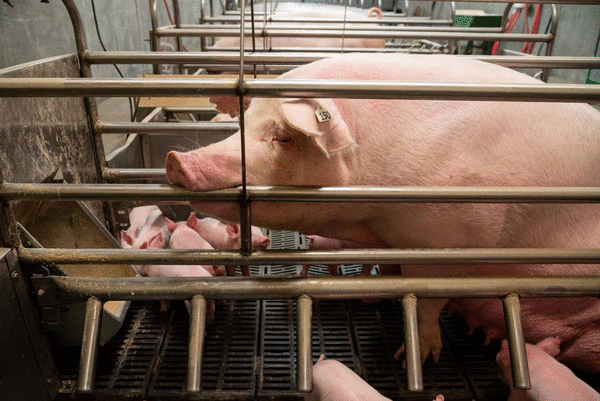
California’s Prop 12 mandates that any pork sold in the state must come from hogs raised by sows, or breeding pigs, allowed at least 24 square feet per animal. A Massachusetts law, passed in 2016, requires the animals, similarly, to be able to turn around.
Compliance added about $1,500 per barn for either building or converting equipment, said Todd Marotz, chief production officer at Wakefield Pork, based in Gaylord, Minn.
“If California citizens want pork raised a certain way, they can put out those requirements and let the consumers decide,” he said.
Not all farmers agree, and some see Prop 12 as a new opportunity in a highly concentrated hog industry dominated by four companies.
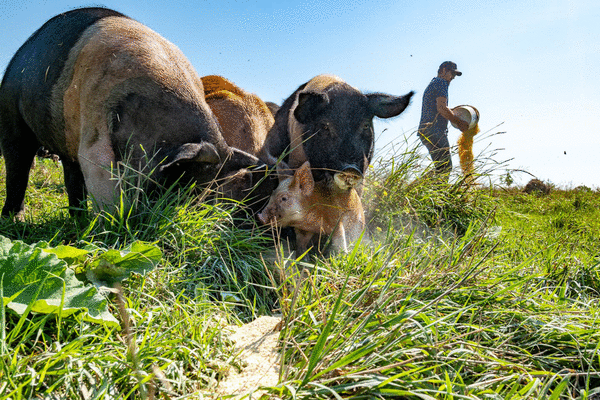
Down a gravel road in Stearns County, outside Belgrade, inside a wooded pasture often captured by her Instagram, Trisha Zachman and her husband, Nolan, are raising hogs differently from conventional pork production sites.
“The farmer is not the enemy in any of this,” said Zachman, who is a finalist for the 2026 Farmfest Woman Farmer of the Year award. “For us, and how we farm, this market fits us perfectly.”
Since 2021, Zachman and her husband have raised heritage breed pigs — typically a little smaller and rarely pink like typical commercial barn hogs — on their west central Minnesota farm. Every six months, they drive to an Albany sale barn where the livestock is loaded onto trucks and shipped to Sioux Center, Iowa, for processing with Niman Ranch, which specializes in meat production of animals raised with access to the outdoors, sunlight and bedding.
“We get them outside, breathe in fresh air, digging in the dirt, rolling in the mud,” Zachman said. “For us, that’s what we want to do with our pigs.”
She also thinks California had a right to pass Prop 12.
“Our food system is very fragile,” Zachman said. “If we have only confined pigs? What if that collapses?”
On Capitol Hill, as early as Thursday, the Senate will start working on the farm bill language, and a nullification is likely to be introduced by Republican Iowa Sen. Joni Ernst, who is not running for re-election.
The provision has lost steam after Kansas Sen. Roger Marshall, who in 2025 talked about “coastal activist agendas” dictating Midwestern farming standards, dropped his co-sponsorship and switched focus to year-round ethanol legislation. Neither of Minnesota’s senators, Democrats Amy Klobuchar and Tina Smith, have supported any override language.
Also, while Austin, Minn.-based Hormel has not supported the legislation, other big meat companies such as Virginia-based Smithfield, which is a subsidiary of the WH Group of China, has supported the measure.
“Along with the rest of our industry, we support a solution that prevents a patchwork of arbitrary state-by-state pork-production laws,” said Ray Atkinson, a Smithfield spokesman in an email. He added that the new laws drive up costs and “have not been informed by science or animal welfare experts.”
The American Meat Producers Association, a new group with ties to farm and food voices opposed to gestational crates, launched a $30 million ad campaign to fight large company lobbying.
Even the pork industry’s most strident supporters, though, acknowledge they might be losing the public messaging war.
“They’re hitting the points that resonate with Americans if they’re less informed on the issue,” said Garner of the pork council. “We’re trying our best to counter that.”
And the stakes may be bigger than just pork. Marotz, the production manager at Wakefield Pork, worries more change could be coming down the road for dairy, turkey and beef producers.
It all comes down to the rising uncertainty around the profitability of a cornerstone industry of the rural Minnesota economy.
“Under a Prop 12 scenario with increased food prices, that’s not a great place to be,” Marotz said.
©2026 The Minnesota Star Tribune. Visit at startribune.com. Distributed by Tribune Content Agency, LLC.




Comments