Blue Origin rocket explosion rattles Jeff Bezos's firm, Amazon and NASA
Published in Business News
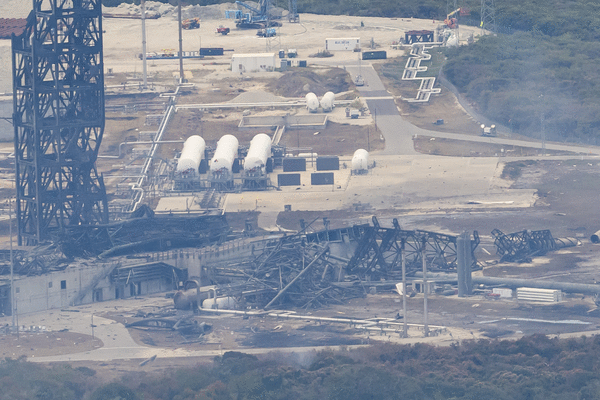
Blue Origin experienced a fiery setback Thursday when its New Glenn rocket exploded on the launchpad in Cape Canaveral, Florida.
The Kent, Washington-based company, started by Amazon founder Jeff Bezos, was testing its rocket before its next planned launch, which was slotted to place 48 satellites for Amazon’s broadband venture, Leo. That launch would have been New Glenn’s fourth mission, and its first with payloads for Amazon.
It's too soon to know what caused the explosion, and it will be some time before Blue Origin shares its findings. No injuries were reported.
With New Glenn now out of commission, Blue Origin, Amazon and NASA, which was counting on Blue Origin to provide one of its two options to land humans on the moon, face an uncertain future.
The space industry so far appears sympathetic to Blue Origin's plight — NASA Administrator Jared Isaacman commented Thursday that spaceflight is unforgiving — and optimistic that Blue Origin will return its New Glenn rocket to operation. But the explosion undoubtedly marks yet another delay for a company that is already seen to be lagging behind its main competitor, Elon Musk's SpaceX.
“I have very little doubt that Blue Origin will get to the bottom of this,” said Stan Shull, the founder of Seattle-based space technology consulting firm Alliance Velocity. “They seem very vision and goal driven, and I don’t expect this to change that, but it’s a setback, and it’s a significant one.
“It’s going to change the timeline of their hopes and dreams.”
Blue Origin's rocket exploded during what’s known as a static fire test, a typical test run before launch to ensure the rocket’s systems are working as expected. Shull described it as filling the rocket with propellant, then briefly firing up the engines.
On Thursday, “right around the time of ignition, the whole thing just blew up in a very spectacular way,” Shull said. “I don’t recall ever seeing one like this before.”
Because the static fire test involves so many of the rocket’s systems, it’s impossible to pinpoint yet which part led to the fiery blowup, said Siamak Hesar, the CEO and co-founder of space tech company Kayhan Space.
Blue Origin had just returned New Glenn to the launchpad after an April incident that delivered a satellite to the wrong orbit. In that case, one of the engines on New Glenn’s upper stage failed to produce enough thrust.
Blue Origin and many in the space industry still considered the April mission a success because the company launched and recovered the recycled booster stage, which propels the rocket off the launchpad and then falls back to Earth while the upper stage continues to space. Blue Origin is one of the few companies that has designed a reusable booster stage.
The incident in April and the explosion Thursday are likely not connected, both Shull and Hesar said. The first mishap involved a problem with the upper stage, which was not in use during the static fire test.
Blue Origin is now down to one New Glenn rocket and will have to make significant repairs to its launchpad, the only one capable of sending New Glenn off.
To Shull, the extent of damage to the launchpad is the “critical path item” to determining how quickly Blue Origin can return to operations.
Launchpads are specific to each rocket, so Blue Origin couldn’t launch New Glenn from another provider’s infrastructure. The company has another launchpad in Texas built for its smaller New Shepard rocket. Blue Origin is building another launchpad at Vandenberg Space Force Base in California, but that wouldn’t send New Glenn to the same orbit as the Cape Canaveral site.
“Losing a rocket is one thing, but having to rebuild their entire launch infrastructure, that’s a much bigger deal,” Shull said.
It’s not clear yet what the explosion and resulting delay will mean for NASA’s moonshot ambitions.
NASA was relying on both Blue Origin and SpaceX to provide lunar landers to put humans back on the moon’s surface in 2028. But both rocket companies have faced setbacks with the rockets they planned to use — New Glenn and SpaceX’s Starship. This month, NASA also tapped Blue Origin to help establish a moon base, with plans to send buggies to the moon’s surface.
On Thursday, NASA Administrator Isaacman said the agency would share updates on any impact to its lunar programs.
“Developing new heavy-lift launch capability is extremely difficult,” Isaacman wrote on X.
On the commercial front, Amazon said Friday the New Glenn explosion won’t affect its broadband network rollout. Amazon’s satellite broadband venture Leo aims to send more than 3,200 satellites to low-earth orbit.
The company has secured more than 100 launches on four rockets, Amazon said Friday, and New Glenn represents less than 25% of its planned launches. Amazon Leo is prepared to use other launch providers while it waits for New Glenn to return to operation, the company said.
Amazon is already falling behind its launch schedule, and the company had to ask earlier this year for an extension to its license with the Federal Communications Commission, which required Amazon to have half of its satellites in place by this summer. Its launches are delayed, Amazon told the FCC, because of bottlenecks with its launch providers, including Blue Origin.
Hesar, from Kayhan Space, didn’t expect Blue Origin to lose ground in its competition with SpaceX, even after one of its rockets exploded.
“There is a kind of understanding in the industry that we do need a very healthy market for launch, and we need healthy competition,” he said. “And I think everyone understands the rocket business is very difficult.”
©2026 The Seattle Times. Visit seattletimes.com. Distributed by Tribune Content Agency, LLC.










Comments