Commentary: The margin of effort -- How election volunteering can help save democracy
Published in Political News
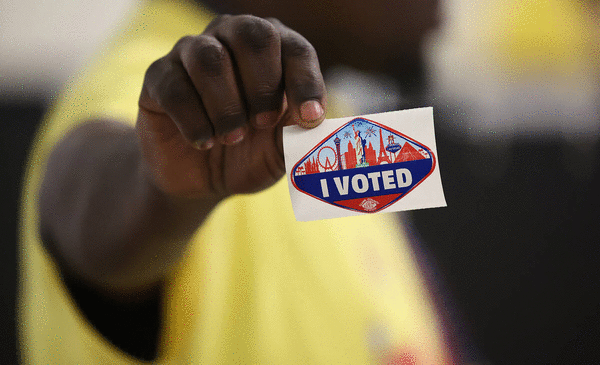
Sometimes it’s the humble actions that matter, which is a lesson for our dangerous time. For years, I’ve volunteered to get out the vote for my preferred candidates. In one election, knocking on doors in a Seattle neighborhood, I spoke with three people who supported my candidate for governor but wouldn’t have voted had I not contacted them: One forgot it was Election Day.
Another didn’t know how to submit an absentee ballot. The third needed a ride to the polls. My impact had nothing to do with eloquence or skill and everything to do with simply showing up. After three recounts, my candidate won by 133 votes in a state of 6.2 million. I’d personally gotten one-fiftieth of the margin. If just a handful of the volunteers on my side had stayed home, or there had been a few more on the other side, Washington state would have had a different governor.
Another time, in a U.S. Senate race, I walked Election Day precincts until my feet hurt, and then continued until the polls closed. The margin this time was 2,229 votes, and I had no idea it would be that close. I also once invited my neighbors to a house party for my friend Lisa, who was running for Seattle City Council. Fifteen people RSVP’d, but only five showed, plus Lisa and her campaign manager.
I apologized for wasting the campaign’s time, but my friend Shep, who’d just retired, was one of the five. He bombarded her with questions, but then, profoundly impressed by her answers, made volunteering for her campaign his full-time job over the next five weeks. Lisa won by 39 votes. Had we not held the house party, she most likely would have lost.
Many of us spend hours a day inhaling the bad news of our dark reality, or we follow the polls like we do our favorite sports teams, elated when our candidates rise, deflated when they fall. Knowing what’s going on is important, but if we put at least some of that energy into electing candidates we believe in, we can change the results, including America’s critical upcoming midterms.
The research confirms our potential impact. A 2024 analysis by political scientists Christopher B. Mann and Katherine Haenschen found that in high-visibility elections like midterms, each potential voter you talk with adds three percentage points to the likelihood that they’ll vote. So if you reach 100 people from a list predisposed toward your candidate, you’ll likely generate three additional votes from people who’d probably otherwise stay home. Volunteer phone calls produce a shade less: 2.3 points per person reached. Neither sounds like much, but if 10,000 volunteers each spend two days and reach 100 voters, that will yield roughly 30,000 votes. That’s larger than the margin for a half dozen of the 2022 Senate and governor races.
If you still feel too bleak to volunteer, or the candidates don’t meet your perfect standard, remember that people have far more room to act before would-be dictators consolidate power. Recently, I met a young Russian woman who joined the protests around Putin’s jailing of dissident Alexei Navalny.
“But then they got smaller, and the risks got greater,” she said. So she stopped. As Navalny, who died in a Siberian prison, wrote in his memoir, “While we were immersed in our petty squabbles to decide whom to label as belonging to which faction, and whether it was appropriate for us to be photographed in their company, we suddenly found ourselves living in a country where people were being thrown in prison for no reason or even murdered.”
Courageous and impactful action is possible even under dictatorships, as when Argentina’s Mothers of the Disappeared demanded the military tell them the fate of their children and helped bring down that murderous regime. But it’s far easier when dictatorial power is still contested and doesn’t control every major institution. So if we fear Trump’s attempts to destroy democracy, this election is a maximum point of leverage, which means doing all we can now to impact it by knocking on doors, making phone calls, sending letters and postcards, supporting grassroots efforts in key states and districts.
Pollsters talk about “the margin of error,” which means their projections aren’t cast in stone. Organizers talk about the “margin of effort,” which is what happens when enough ordinary people join a campaign and reach out to others. The more each of us can become part of that margin, the better our chances of saving our democracy.
____
Adapted from Paul Loeb’s "The Impossible Will Take a Little While: Perseverance and Hope in Troubled Times" (Basic Books, Oct. 13, 2026). theimpossible.org. Paul spent 12 years running nonpartisan voting projects. His books have 350,000 copies in print.
Paul Rogat Loeb is the author of "Soul of a Citizen" and "The Impossible Will Take a Little While," with 300,000 copies in print between them. See paulloeb.org
_____
©2026 The Fulcrum. Visit at thefulcrum.us. Distributed by Tribune Content Agency, LLC.














Comments