In Senate and in call with Trump, NC's Ted Budd pushes to go ahead with hemp ban
Published in Political News
In a last-minute addition to a law passed to reopen the federal government, Congress added last November a provision that would upend much of the booming hemp industry in the United States.
Now, lawmakers have added a new provision to a spending bill that would delay the law from taking effect, reportedly at the request of the White House.
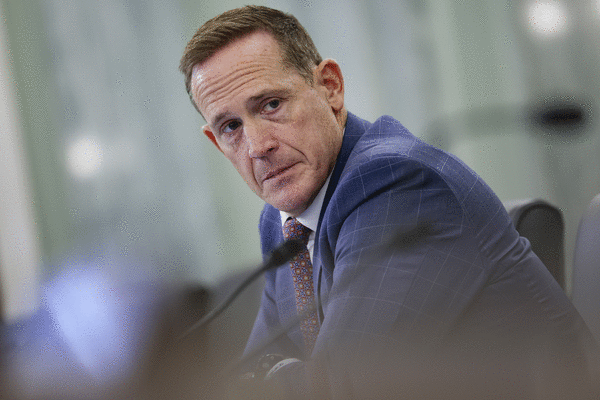
And U.S. Sen. Ted Budd, a Republican from Davie County, North Carolina, is at the center of a battle over whether those restrictions should move forward — a battle that has drawn direct involvement from the president.
The hemp provision is set to take effect this November. The language was added by Republican Sen. Mitch McConnell of Kentucky, who championed hemp legalization through the 2018 Farm Bill but later sought to close what he called a “loophole” that allowed intoxicating hemp-derived THC products to be sold.
But now, pressure is coming from White House officials who have reportedly been lobbying Congress to delay that ban. The New York Times reported that doing so would benefit hemp CEO Bret Worley, who is the son-in-law of Susie Wiles, the president’s chief of staff.
As for President Donald Trump’s involvement, a spokesman for Budd said, “Senator Budd had a friendly call with President Trump discussing legislative efforts regarding THC. Senator Budd outlined his concerns regarding any delay to closing the hemp loophole.”
Budd has been spearheading much of the opposition to the delay, including filing an amendment with other senators on Wednesday to strip the provision from the spending bill. Doing so would allow the law to take effect, banning many hemp-derived THC products.
‘Not going to back down’
Before filing the amendment, Budd took to the Senate floor Wednesday to strongly oppose the delay.
“United States senators, each of us has a responsibility to the millions of parents that we represent to put the safety and the welfare of American kids first. That’s exactly why just nine months ago on this very floor, 76 members of this body voted to close the hemp loophole that allowed these dangerous substances to be sold in unregulated retail stores,” Budd said.
Budd said that since last November, the hemp industry has attempted to delay efforts to close the “loophole.” He also accused companies of using deceptive branding that mimics well-known candy and snack products and said their packaging is “unmistakably designed to appeal to kids.”
“What’s most concerning is how easy it is for a child to walk into a convenience store and pick up what looks like their favorite snack or their favorite candy, without realizing they’re actually buying an intoxicating substance,” he said.
The products, Budd said, are affecting adults too, with some now unable to hold jobs that require drug testing.
More children are also ending up in emergency rooms because of cannabis poisonings. He said cannabis-related emergency department visits among minors in North Carolina increased 969% between 2017 and 2025.
“I am appalled at the well-oiled, slick lobbying machine, which is very well-connected in this town,” Budd said. “I’m not going to back down on this. I’m not going to waver or stop until this life-threatening loophole is closed permanently. We’re going to have this fight before the end of this Congress, and I can assure you I’m not going to stop fighting to protect American children.”
Budd also said he has had “numerous conversations with the White House” about the issue and is willing to have a broader conversation about marijuana.
The Trump administration moved marijuana from a Schedule I drug to Schedule III in December, easing medical research barriers.
News outlets such as CNBC have reported that move followed a yearlong push by cannabis executives, billionaire allies and political operatives.
NC efforts to regulate hemp
While the federal government is sorting out what to do with hemp, North Carolina lawmakers were also considering legislation to regulate the industry. But on Tuesday, the state House declined to take up a compromise bill negotiated by some members that had already passed the Senate. The bill would have prohibited anyone under 21 from purchasing hemp products and mirrored the federal hemp ban. The ban would have stood regardless of what the federal government opted to do.
Asked by The News & Observer whether potential federal action influenced the North Carolina bill, Republican House Speaker Destin Hall said he did not believe it played a significant role in the House’s decision not to take up the measure.
“I don’t know that any of that really played a huge role in the bill not moving because that bill basically was going to create state law regardless of what the federal government did one way or the other,” Hall said.
“Some members felt it was overbroad. Some members just, frankly, wanted to learn more about it. It’s a complicated issue.”
_____
©2026 Raleigh News & Observer. Visit newsobserver.com. Distributed by Tribune Content Agency, LLC.















































Comments