New fossils suggest human evolution was more crowded than scientists thought
Published in Lifestyles
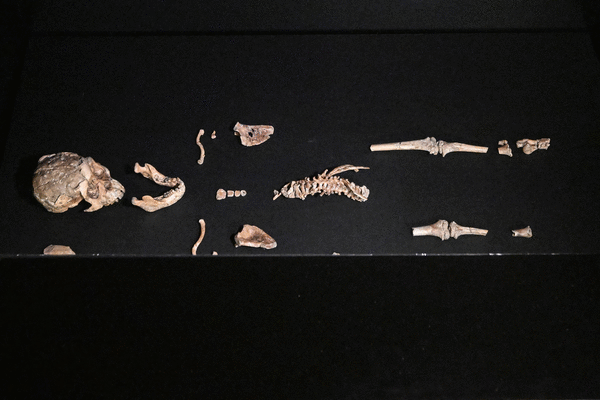
New fossil discoveries are reshaping scientists’ understanding of a pivotal chapter in human evolution, revealing that several human ancestor lineages lived side by side nearly 3 million years ago.
The findings, published in separate studies in the journal Nature, come from the Afar region of northeastern Ethiopia, one of the world’s richest sources of early human fossils. Together, they suggest the evolutionary landscape that gave rise to modern humans was far more diverse than previously recognized.
One study, led by the University of Nevada, Las Vegas, reports that new fossils from the Ledi-Geraru area date between about 2.8 million and 2.6 million years ago. Researchers identified evidence of early members of the genus Homo, the group that eventually led to modern humans, living alongside an unidentified species of Australopithecus. The fossils indicate that Australopithecus persisted in the region longer than expected and that multiple non-robust hominin lineages coexisted before 2.5 million years ago.
The discoveries fill a critical gap in the fossil record from a poorly documented period when major evolutionary changes were unfolding. Researchers say the evidence points to a more complex picture than a simple progression from one ancestor to another. Instead, several closely related species appear to have occupied the same landscapes at the same time.
A January study, led by the University of Chicago, describes a partial lower jaw from the nearby Mille-Logya area that researchers attribute to Paranthropus, a robust-jawed hominin known for its powerful chewing apparatus. Dated to between 2.5 million and 2.9 million years ago, the fossil is among the oldest known examples of the genus.
The discovery is significant because Paranthropus had not previously been identified in the Afar region. Its presence there expands the known geographic range of the genus and suggests it was able to thrive across a wider variety of habitats than scientists once believed.
Taken together, the studies indicate that eastern Africa hosted as many as four hominin lineages between 3 million and 2.5 million years ago: early Homo, Paranthropus, Australopithecus garhi and the newly recognized Australopithecus form from Ledi-Geraru.
Rather than a single ancestral line steadily evolving toward modern humans, the evidence points to an evolutionary “bush” of related species experimenting with different adaptations. Scientists say the discoveries underscore how much remains unknown about the origins of Homo and the environmental pressures that shaped humanity’s earliest ancestors.
©2026 The Baltimore Sun. Visit at baltimoresun.com. Distributed by Tribune Content Agency, LLC.























Comments