Review: Broadway's strange season gets a boost from 7 acting powerhouses
Published in Entertainment News
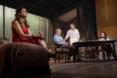
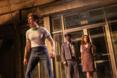
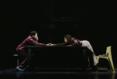
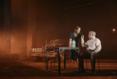
Broadway, top-heavy with musical parodies and attention-grabbing revivals, is having a strange season by all accounts. But actors from all quarters of the profession are still flocking to New York for the kind of substantive material that is becoming harder to come by on screen.
It's thrilling to see first-rate talents, such as Adrien Brody in "The Fear of 13" and Jon Bernthal and Ebon Moss-Bachrach in a stage version of the film "Dog Day Afternoon," test their mettle in different mediums. But it's just as satisfying to watch Olympian stage athletes such as John Lithgow ("Giant") and Nathan Lane and Laurie Metcalf (in "Death of a Salesman") set even more formidable challenges for themselves.
The play is still the thing for these powerhouse performers, even if drama as good as Arthur Miller's masterpiece is a rare occurrence in any age. But these actors are after more than a prestige showcase. They're looking for an artistic lifeline, a way of connecting themselves and their audience with a tradition that extends our collective horizon and encourages us to take a longer view.
'The Fear of 13'
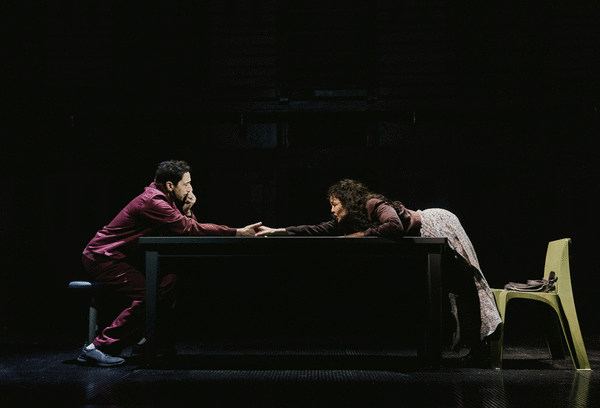
The daredevil intensity that won Adrien Brody two Oscars translates forcefully to the stage in his Broadway debut in "The Fear of 13." Reprising his Olivier-nominated London performance, Brody plays Nick Yarris, the convicted murderer who spent more than 21 years on death row before being exonerated for a crime he didn't commit.
In David Sington's 2015 documentary of the same title, Yarris himself relates his tale, keeping those of us unfamiliar with the outcome of his epic struggle to clear his name in taut suspense until the very end.
The play by Lindsey Ferrentino (who wrote the book for the musical "The Queen of Versailles") takes a different tack, populating the stage with the characters we come to know in the film only through Yarris' vivid descriptions. The effect is sometimes unnecessarily clamorous, but the core of the drama is quietly gripping.
Brody wisely doesn't attempt an impersonation. He offers instead a soul-print in which Yarris' plight is captured in the splayed nerve endings of the stage character he creates.
Some film actors seem lost when they make a foray onto the stage. Not Brody, whose chiseled, wiry presence is ever in motion, flailing, ducking, wincing, yearning. But it's his voice that exerts the most hypnotic force, moving from defensive parry to inner rumble that takes the entire audience at the James Earl Jones Theatre into his confidence.
I found myself leaning in during his performance as Jacki Miles (an extraordinary Tessa Thompson), the volunteer from the abolitionist group, elicits Nick to give words to what's inside him. The production, directed with the brooding fluidity that is David Cromer's calling card, is most alive in the evolving dynamic between Nick and Jacki, whose romance happens by degrees then all at once before reality intervenes and the criminal justice bureaucracy grinds to a halt.
Brody couldn't ask for a better scene partner than Thompson, an accomplished theater actor who gives haunting texture to a character unique in both her imperfections and seductive appeal. Their chemistry presents a rare instance of celebrated screen actors releasing each other to new heights on stage.
'Death of a Salesman'
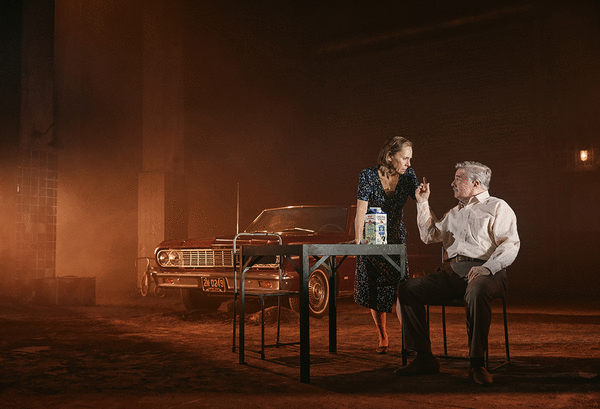
Joe Mantello's "Death of a Salesman" isn't your grandfather's version of the Miller classic. The production at the Winter Garden Theatre, starring Nathan Lane and Laurie Metcalf, unfolds in a surreal garage space, where Willy Loman parks his car after returning from an aborted sales trip and a phantasmagoria of his exhausted life plays out around him.
Mantello opts for a 1948 draft of the script to discover what Miller may have originally intended before the play's first director, Elia Kazan, brought his collaborative influence to bear. Realism is achieved not through bare-bones scenic furniture but through the combustible relationships of characters who exist with one another in a purgatory of disillusionment.
Lane's Willy is both a paternal tyrant and a wounded bear, growling if anyone interrupts him yet unable to conceal his soft underbelly. It's an assured, intelligent performance, if a touch too stentorian. But everyone has a different ideal version of the character. Mine is Dustin Hoffman. My theater companion said that his is Brian Dennehy. And I remember my mentor, who saw the original 1949 production, holding up Lee J. Cobb as the greatest ever Willy Loman. Lane joins this august company.
Metcalf, bringing all her blue-collar brilliance to the role, stiffens Linda's spine. Clear-eyed and ruthlessly unsentimental, her Linda is a wife before she is a mother, and she lets her sons know that if they turn their back on their father, she will have no choice but to turn her back on them.
The production employs two sets of sons: a grown-up pair (played by Christopher Abbott and Ben Ahlers, both superb) and a younger pair (played by Joaquin Consuelos and Jake Termine) for flashback scenes. This arrangement alters the play's emotional architecture. The motel scene, in which the younger Biff (Consuelos) discovers that his father has been cheating on his mother, doesn't have the same cathartic impact as the final confrontation between Willy and grown-up Biff, which had the audience convulsing in sobs the night I attended.
Abbott's performance, along with Metcalf's, is the production's most fully realized. While Metcalf's Linda adopts a facade of stoicism to shield her family from the grief erupting in her, Abbott's Biff is forced to reveal the broken man behind the defiant veneer. His breakdown moment with Lane's Willy, whose explosive temper is finally subdued by his son's desperate need to be seen, draws out all the tragic heartbreak of a classic that has been liberated from the customary domestic trappings only to be made more intimate. If the scope of the work has been narrowed, the politics have been wrenchingly personalized.
'Dog Day Afternoon'
Some have wondered why anyone would attempt to re-create on stage one of the classics of 1970s filmmaking. But this production at the August Wilson Theatre makes a good deal of sense on paper.
Stephen Adly Guirgis, a New York playwright who specializes in urban pressure-cooker dramas, has a gift for writing subway strap-hanger harangues. The dialogue in his plays, a breathlessly hilarious assault, would seem an ideal way of reanimating the movie's desperate outer-borough dreamers.
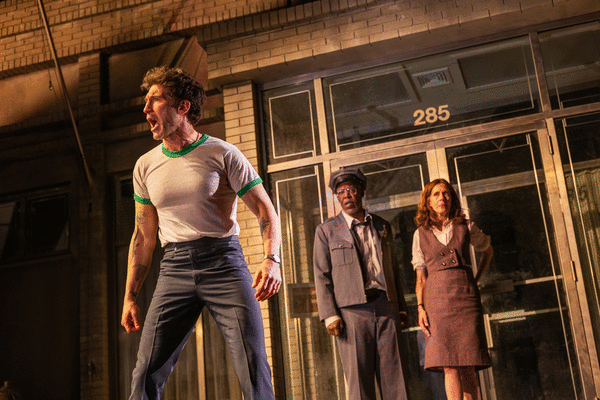
Jon Bernthal and Ebon Moss-Bachrach, both celebrated for their work on FX's "The Bear," have more going for them than their admiration for the film. Bernthal, who plays Sonny, has his own wayward machismo and hapless sensitivity, the very qualities that made Al Pacino unforgettable in the role of the bungling bandit with a Catholic conscience. And Moss-Bachrach brings a menacing edge of dissociated weirdness to Sal, the character John Cazale played as a neighborhood space alien.
No one could argue with a cast that includes the great John Ortiz as Detective Fucco, the good cop trying to stave off the hardball tactics of his FBI counterpart, and Jessica Hecht, a treasured New York theater veteran, as Colleen, the head bank teller who, in an age demoralized by Nixon, the Vietnam War and rampant crime, takes her job with a refreshing moral seriousness. But the production, based on the Life magazine article about the botched 1972 Brooklyn bank robbery and the 1975 Sidney Lumet film that arose from this twisted true-crime tale, turns a dramatic thriller shot through with observational humor into an overcooked farce rife with outlandish caricatures and cartoon Brooklyn accents.
Rupert Goold, a British director with a gold-plated CV, was the wrong choice for a work that depends on New York street cred. Yes, it's a period piece, but a period that is still for many Broadway theatergoers a living memory. A stage adaptation can't duplicate the way Lumet visually distilled the rough-and-tumble New York zeitgeist of the tumultuous early 1970s. Tragicomedy repeats as embarrassing parody. The sampling of funk and glam rock classics momentarily distracts us from the nonsensical staging choices and hopped-up gags, but only for so long.
'Giant'
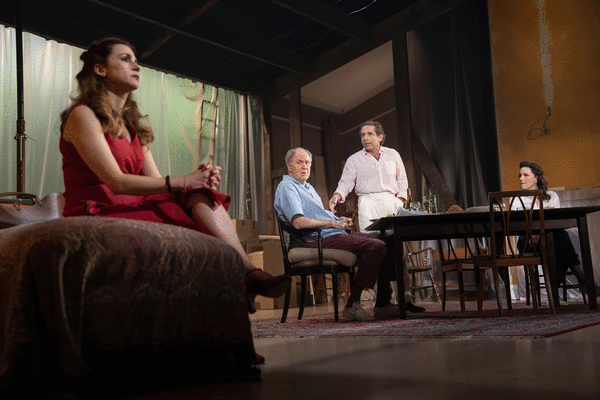
Roald Dahl, the British author whose disturbing fictions ("The BFG," "Matilda," "Charlie and the Chocolate Factory") turn a gimlet eye onto human nature, was never one for making nice. And in "Giant," John Lithgow, reprising his Olivier Award-winning performance, portrays the author in all his dyspeptic glory.
The play, a British import by Mark Rosenblatt set in the summer of 1983, focuses on a moment of crisis that Dahl has inflicted on himself. A book review he wrote has caused a firestorm of controversy for comments on Israeli foreign policy that were seen (for good reason) as outright antisemitic.
Tom Maschler (Elliot Levey), his cool-handed British publisher accustomed to his star writer's intemperate ways, has arrived at Gipsy House, the author's quaint domestic oasis, ahead of a representative from Dahl's American publisher, Farrar, Straus and Giroux. Jessie Stone (Aya Cash), a Jewish sales director at FSG, is offended by Dahl's ill-judged words and alarmed by the potential business impact.
Felicity (Rachael Stirling), Dahl's interior designer fiancée who is undertaking a major renovation of Gipsy House while hoping to do a more subtle remodeling of her husband-to-be, is determined to smooth the way for a graceful afternoon of damage control. But Dahl doesn't take kindly to being managed.
"Giant," which won the 2025 Olivier Award for best new play, begins somewhat earnestly as a debate drama. Dahl and Jessica argue their positions from their different lived experiences. Dahl assumes that Jessica's background as a New York Jew has clouded her sympathy for the innocent casualties of Israel's 1982 invasion of Lebanon. She is shocked by his blatant stereotyping and his inability to distinguish a foreign government's policies from the views of Jewish people worldwide.
Tom, whose family fled Nazi Germany when he was a boy, is a thoroughly assimilated, tennis-obsessed Englishman who brings his own more conciliatory perspective to the discussion as a British Jew. Felicity makes clear that her loyalty is to her future husband, though she keeps everyone against their will at this emergency summit.
The production, silkily directed by Nicholas Hytner at the Music Box, takes place at the sun-dappled country house that designer Bob Crowley has turned into a fairy tale setting, if fairy tales could look like partial construction sites. But the only ogre in this story is Dahl.
The play is dominated by Lithgow's towering portrait of the artist as a weary old giant who refuses to concede an inch of ground. His antagonistic manner is at full toxic strength, and even when he learns of the harrowing medical history of Jessica's son and bonds with her over the boy's special needs, he remains bitterly, exasperatingly and increasingly fiendishly intractable.
Lithgow's performance suggests without any softening of tone or characterization that Dahl's deep well of feeling for the suffering of children is the source of his harsh condemnation of Israel's actions in Lebanon. Rosenblatt's play, though formulaic at times, contains a twist worthy of Dahl himself, as the protagonist grows more monstrous as he digs deeper into his righteous convictions.
It takes a brave actor to subvert an audience's sympathy, but Lithgow's magisterial performance wins our admiration not by being likable but by making the more perversely hateful aspects of his character as shockingly real as anything in Dahl's fiction.
©2026 Los Angeles Times. Visit latimes.com. Distributed by Tribune Content Agency, LLC.







Comments