Death toll from Venezuela's twin earthquakes rises to 6,125
Published in News & Features
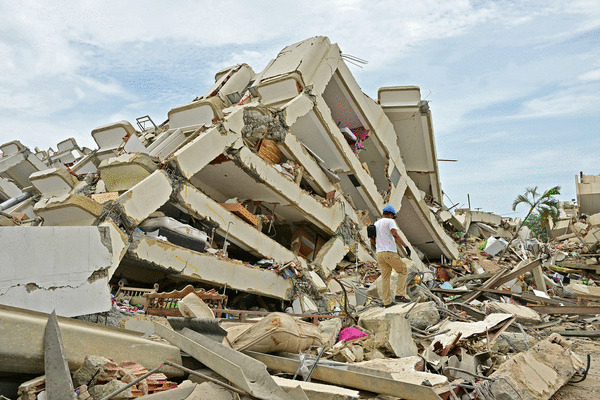
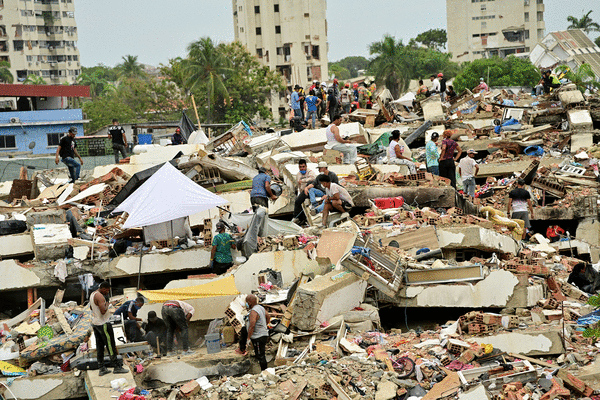
Venezuela’s official death toll from the devastating twin earthquakes that struck the country’s north-central region on June 24 has climbed to 6,125, according to a reconstruction bulletin released late Monday, as authorities reported continued progress in evaluating damaged homes while warning that thousands of residences remain unsafe more than five weeks after the disaster.
The update, issued after a 10-day gap in official casualty reporting, added 579 deaths to the previous toll of 5,546 announced on July 24, underscoring that the human cost of the disaster continues to mount more than five weeks after the earthquakes struck.
The interim government said the number of people rescued alive remains unchanged at 6,462, while hospitals across the country have now treated 60,992 patients since the magnitude 7.2 and 7.5 earthquakes struck just 39 seconds apart, devastating large sections of La Guaira, Caracas and neighboring states in what has become Venezuela’s deadliest natural disaster in decades.
Despite the passage of more than a month since the disaster, authorities acknowledged that the search for victims has not ended.
La Guaira Gov. José Alejandro Terán told local media that about 1,400 people remain missing, suggesting the official death toll could continue to rise as emergency crews and volunteers keep searching collapsed buildings and debris fields throughout the coastal state that suffered the heaviest destruction.
The continuing increase in fatalities illustrates the enormous complexity of recovery operations in areas where collapsed high-rise apartment buildings and other large structures have complicated efforts to recover victims.
The government’s latest bulletin also provides its most comprehensive assessment to date of the damage to Venezuela’s housing stock.
Authorities said engineers have now inspected 43,679 homes across the affected region.
Of those, 25,325 have been declared habitable, allowing residents to return, while 9,866 have been classified as suitable only for restricted occupancy because of structural damage requiring repairs or continuous monitoring.
Another 6,433 homes have been designated as high risk, meaning authorities consider them unsafe for habitation because of extensive structural damage or the possibility of collapse.
The housing assessment has become one of the central components of Venezuela’s reconstruction effort as engineers work neighborhood by neighborhood to determine which structures can be repaired and which must be demolished.
Officials said the government has so far delivered 287 replacement homes to families displaced by the earthquakes, though that represents only a small fraction of the housing assistance expected to be required.
The interim government has previously announced plans to provide approximately 4,000 replacement homes by the end of the year as part of a broader reconstruction strategy aimed at moving displaced families out of temporary shelters and into permanent housing.
To help address the housing shortage, Venezuela’s National Assembly last week approved a new rental law designed to encourage more property owners to place vacant apartments and houses on the rental market.
Officials have argued the legislation will expand housing options for families who lost their homes while reconstruction continues, replacing legal restrictions that many property owners said had discouraged rentals for years.
Even with those efforts underway, the displacement crisis remains substantial.
According to the latest available official figures, nearly 24,000 people continue to live in temporary camps established in Caracas and La Guaira following the earthquakes. Thousands of additional families have sought shelter with relatives or friends while waiting for repairs to their homes or the completion of replacement housing.
The reconstruction bulletin also highlighted the scale of the cleanup operation now under way.
Authorities said crews have removed 346,755 metric tons of debris, equivalent to 16.51% of the rubble generated by the collapse of hundreds of buildings.
Although officials described the pace of debris removal as steady, the figures also underscore how much work remains.
Previous joint estimates by the Venezuelan government and the United Nations Development Program placed the total volume of debris at well over 2 million metric tons, making the cleanup one of the largest engineering and logistical operations in Venezuela’s modern history.
The government has said the rubble removal effort involves separating recyclable construction materials from hazardous waste so that concrete, steel and other materials can be reused in reconstruction projects whenever possible.
Authorities have also begun controlled demolitions of buildings determined to be at imminent risk of collapse, a process expected to accelerate as structural inspections continue across the disaster zone.
The demolitions are intended to eliminate dangerous structures before reconstruction begins in the hardest-hit neighborhoods, particularly in La Guaira, where numerous apartment towers suffered catastrophic damage during the earthquakes.
Government officials have repeatedly said rebuilding the country will require years rather than months.
©2026 Miami Herald. Visit at miamiherald.com. Distributed by Tribune Content Agency, LLC.






Comments